
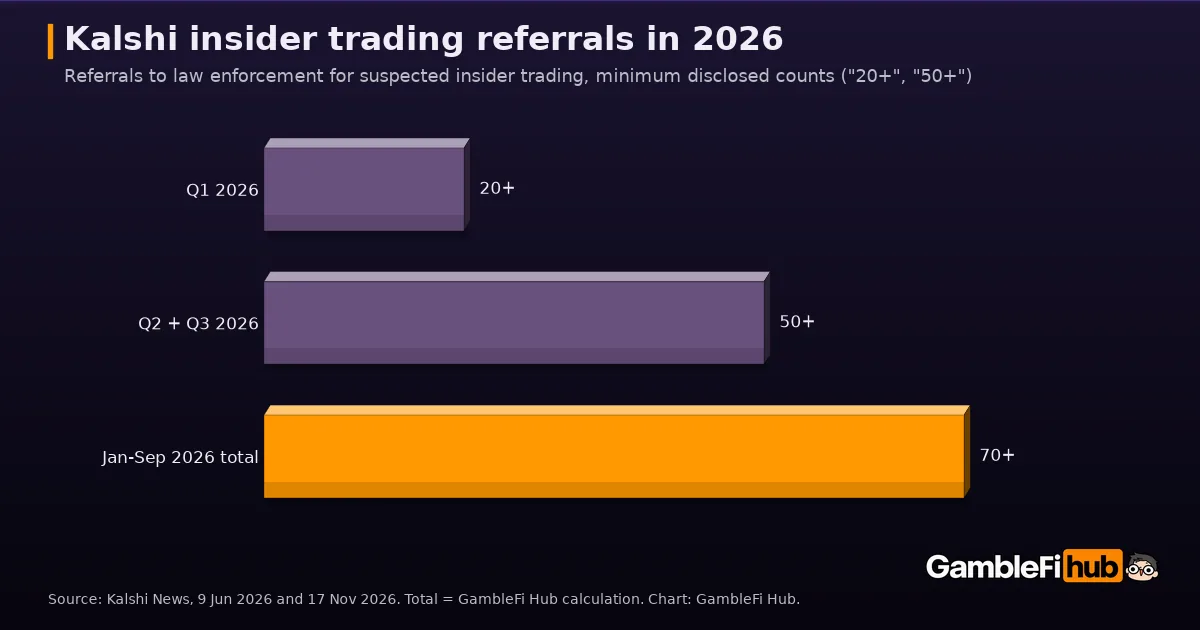
Kalshi has put a number on insider trading for the second time this year. On 17 November 2026 the exchange said it had accepted the third-quarter report of its independent Market Integrity Committee and disclosed more than 50 referrals to law enforcement for suspected insider trading in the second and third quarters. Together with the 20-plus referrals it reported for the first quarter, that is at least 70 cases sent to authorities in nine months. The same announcement launched an advertising campaign with Martha Stewart reminding users that insider trading is banned on the platform.
What the committee found
The committee, Wharton professor Daniel Taylor and Lisa Pinheiro of Analysis Group, reviewed anonymised trading data from every market category. Its main finding: markets representing about 98% of trading volume carry a lower risk that anyone holds material nonpublic information, because outcomes such as live sports, weather and crypto prices are publicly observable. For the rest it recommended tailored alert thresholds rather than one setting per broad category.
The examples Kalshi gives are telling. Its crypto “Pre-Market” subcategory mixes markets on whether a company will launch a token with markets on the token’s later valuation; the first is exposed to insiders, the second much less. Kalshi will regroup 21 such mixed subcategories, give each a risk rating and build a tiered surveillance algorithm that sends most alert capacity to higher-risk markets. The committee also tested account-level measures such as profitability and success rates across markets, and will look at spoofing next.
Key facts
Report: Market Integrity Committee, Q3 2026, accepted by Kalshi on 17 Nov 2026.
Data reviewed: 500 million historical trades, nearly 900,000 surveillance alerts, over 44 billion order book updates, 288 million recent trades worth $48 billion.
Scope: 5,585 market series in 421 subcategories; 21 subcategories to be restructured.
Referrals: 20+ in Q1 (disclosed 9 Jun 2026), 50+ in Q2 and Q3 (disclosed 17 Nov 2026).
Committee formed: announced 5 Feb 2026.
Our numbers
Adding the two disclosures gives at least 70 referrals from January to September, and the Q2–Q3 figure works out to 25 or more per quarter against 20 or more in Q1 (see chart). Kalshi’s own data also gives a sense of scale. Nearly 900,000 alerts across 500 million historical trades is roughly one alert per 560 trades, or 1.8 per 1,000. The 288 million recent trades worth $48 billion average about $167 each. If 98% of that volume is lower risk, the higher-risk 2% is still around $960 million of trading. The 21 subcategories to be reworked are 5% of all 421, and each subcategory holds about 13 market series on average.
The disclosure is also thinner than the first one. The June report listed 150-plus investigations, 100-plus potential insider trades blocked by new screening and 5 Kalshi disciplinary actions alongside the referrals. When Kalshi set up the committee on 5 February, it said the committee would publish statistics on flagged trades, investigations opened and closed and disciplinary proceedings. The 17 November release gives only the referral count. It came 161 days after the June report and 285 days after the committee was announced.
Why it matters for GambleFi
Insider risk is the open flank of prediction markets: from the UK election-date bets to the Pentagon memo on staff trading and the CFTC look at candidates betting on their own races. Days before the report the CFTC also made Kalshi pause its Trump mention contracts over manipulation risk. For iGaming token (GambleFi) projects the token-launch example matters most: a market on whether a token launches is a classic insider market, while short-term crypto price contracts sit in the low-risk bulk. Onchain venues without KYC cannot screen employment the way Kalshi now does, so their surveillance has to work from wallets alone. Our GambleFi FAQ explains how prediction markets and iGaming tokens connect. Kalshi’s figures are its own and have not been checked by a regulator.