
US Defense Secretary Pete Hegseth has barred military members and Defense Department civilians from using nonpublic information to trade on any financial platform, and the memo names prediction markets Polymarket and Kalshi. The one-page directive is dated 20 October 2026 and was sent to senior Pentagon leadership, combatant commanders and the heads of Defense agencies and field activities. CBS News obtained it first; the Associated Press and DefenseScoop also reviewed it, and DefenseScoop said a source confirmed its authenticity.
What the memo says
The ban covers financial transactions made directly or through a third party, on “traditional betting platforms and prediction markets such as ‘Polymarket’ or ‘Kalshi’”. “This prohibition applies whether the transaction is informed by classified or unclassified information,” Hegseth wrote. Violations “may result in administrative, disciplinary, and, where appropriate, criminal action under the Uniform Code of Military Justice and/or applicable federal law”.
The memo frames the issue as operational security first. “Our enemies watch movements in these markets,” it says. “When an American Service member, intelligence professional, or other Department civilian engages in a financial transaction on a military outcome, they create a signal,” one that foreign intelligence services could use to anticipate movements, targets and timing. It adds a conflict-of-interest argument: “A logistician with money riding on a strike date has an interest in that date.”
The cases behind it
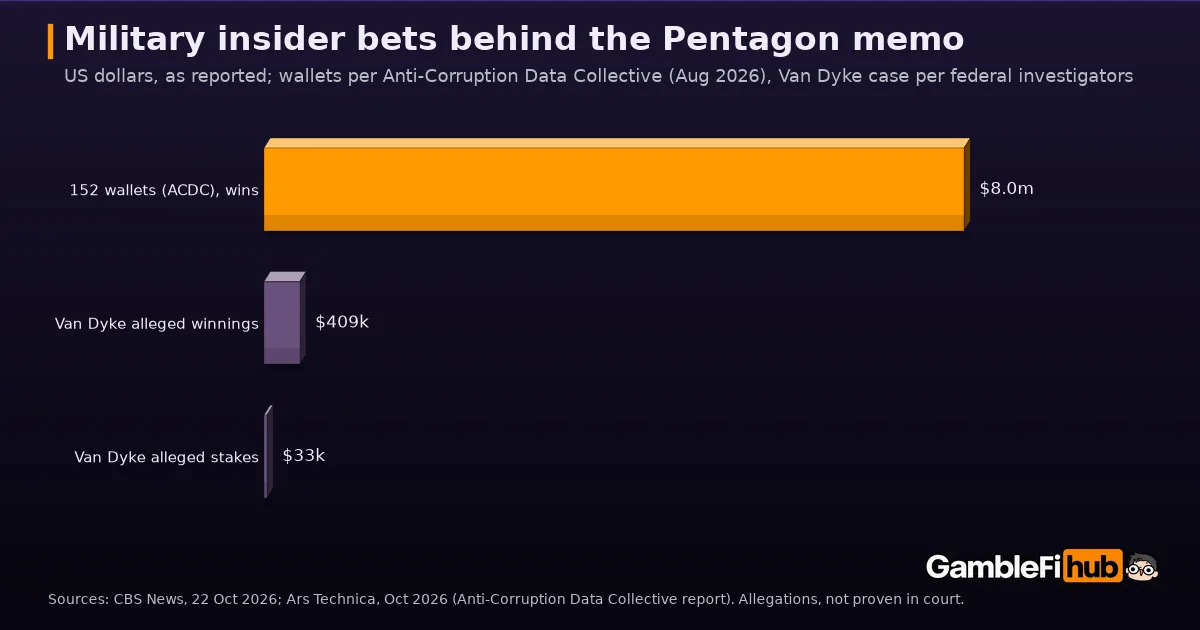
The directive follows the April arrest of Army Master Sgt. Gannon Ken Van Dyke, who prosecutors say used inside knowledge of the operation to capture Nicolás Maduro to bet on Polymarket. CBS reports federal investigators believe he staked more than $33,000 within hours of the January announcement and won more than $409,000; he has pleaded not guilty. In August the Anti-Corruption Data Collective reported 152 suspicious wallets that made longshot bets on military and defence markets and won a combined $8 million, Ars Technica notes, and Reuters reported that Polymarket had referred dozens of possible military insider cases to the Justice Department. Kalshi and Polymarket already ban insider trading in their own rules; the memo adds military discipline and criminal exposure on the trader’s side.
Key facts
Issued by: Defense Secretary Pete Hegseth, memo dated 20 Oct 2026 (reported 22 Oct).
Applies to: service members, intelligence professionals and Defense Department civilians.
Scope: any financial transaction using nonpublic information, classified or unclassified, direct or via a third party.
Platforms named: Polymarket, Kalshi, plus traditional betting platforms.
Sanctions: administrative, disciplinary or criminal action (UCMJ or federal law).
Status: internal directive; the memo itself has not been posted on a government website.
Why it matters for GambleFi
Polymarket’s international venue settles onchain, so outside researchers can trace suspicious positions wallet by wallet, as in the 152-wallet report. The same transparency applies to iGaming tokens, also called GambleFi tokens, and to onchain betting exchanges such as SX Bet. Insider trading on event markets is now drawing action from several directions: UK courts have sentenced election-date insider bettors, the CFTC is probing candidates who trade their own races, and its chair has said he is watching midterm markets for manipulation. Our GambleFi FAQ covers the basics. This is a news report, not legal, financial or gambling advice.