
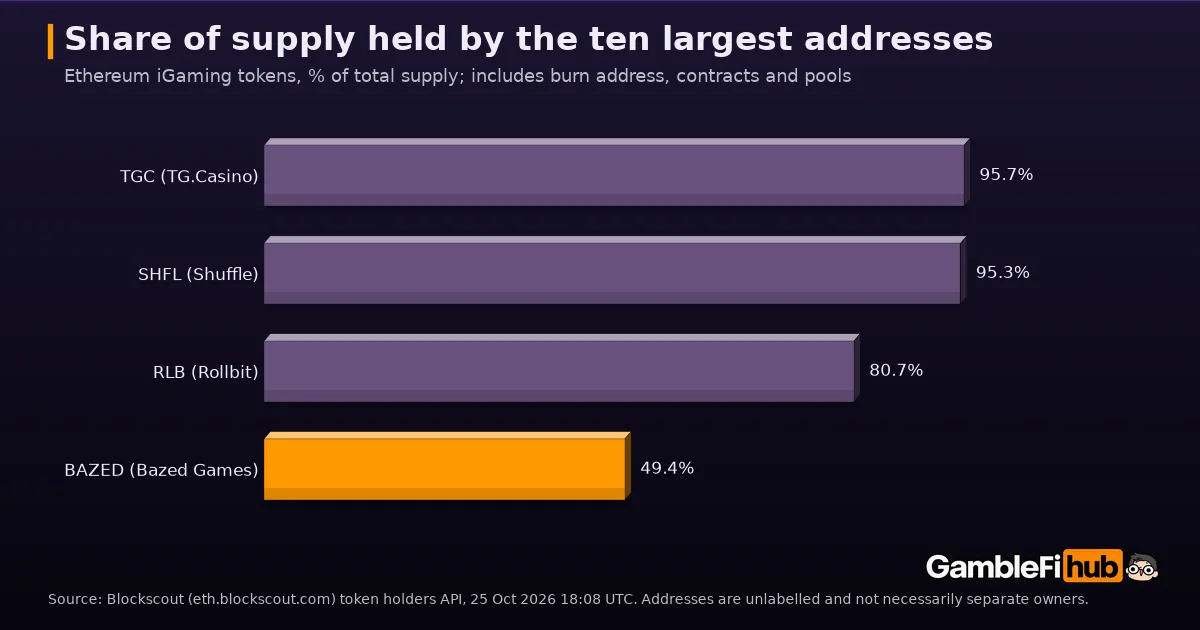
The ten largest addresses hold between 49% and 96% of the total supply of the four Ethereum-based iGaming tokens we checked on 25 October 2026: 95.7% for TG.Casino (TGC), 95.3% for Shuffle (SHFL), 80.7% for Rollbit (RLB) and 49.4% for Bazed Games (BAZED). We pulled the top holders from the Blockscout explorer and sorted each address into burn address, smart contract or ordinary wallet. These are balances by address, not by owner, and the top ten include dead addresses, staking contracts and trading pools.
Shuffle (SHFL): four wallets hold 79%
SHFL has 7,836 holders. The largest address holds 30.3% of the 1 billion total supply Blockscout reports, and the top four unlabelled wallets together 79.2%. The dead address holds a further 8.1%; the remaining top-ten slots are small, including a Sablier vesting contract (1.7%) and a Uniswap V3 pool (1.0%). Seven of the ten are ordinary wallets, which Blockscout does not label. Shuffle’s allocation page lists 31.2% for the treasury and 25% for the team, with the team and early-contributor shares vesting over 36 months after a 6-month cliff, but the chain does not say which wallet holds which allocation, so we do not match them.
Rollbit (RLB): one wallet holds 63%
RLB has 20,179 holders, the most of the four. The largest address holds 62.8% of the 1.55 billion supply and the second 9.9%. Six of the top ten are unlabelled wallets, holding 76.9% together; two Uniswap V3 pools and two other contracts hold 3.8%.
TG.Casino (TGC) and Bazed (BAZED)
TGC has 3,566 holders. Its largest address is a staking contract, StakingManagerV2, with 40.9%; the dead address holds 23.9% and one wallet 19.8%. Contracts account for 50.2% of the top ten and four ordinary wallets for 21.7%. BAZED has 6,798 holders and the lowest concentration: its Uniswap V2 pool holds 25.0% and a revenue-staking contract 8.6%, and eight ordinary wallets hold 15.8% between them.
Key facts
Source: Blockscout token-holder API, 25 October 2026 at 18:08 UTC; shares are of total supply as Blockscout reports it.
SHFL: 7,836 holders; top 1 30.3%, top 10 95.3% (burn address 8.1%, contracts 2.7%, wallets 84.5%).
RLB: 20,179 holders; top 1 62.8%, top 10 80.7% (contracts 3.8%, wallets 76.9%).
TGC: 3,566 holders; top 1 40.9% (staking contract), top 10 95.7% (burn address 23.9%, contracts 50.2%, wallets 21.7%).
BAZED: 6,798 holders; top 1 25.0% (Uniswap pool), top 10 49.4% (contracts 33.6%, wallets 15.8%).
Not covered: iGaming tokens on Solana, BNB Chain and Arbitrum; public endpoints for them were not usable for this check. RAIN has its own post.
How to read it
Concentration is normal for tokens launched with large team, treasury and vesting allocations, and it is not evidence of wrongdoing. What it changes is how a token behaves: when a few addresses hold most of the supply, the float that actually trades is smaller than the total, and one transfer can move the price. A dead address or a staking contract is not a seller in the short term, while an unlabelled wallet could be a treasury, an exchange, a vesting wallet or a single person. Large balances in contracts also say nothing about how many people stake.
Why it matters for GambleFi
An iGaming token (also called a GambleFi token) is meant to give holders burns, staking rewards or revenue share from a casino, as explained in our game mechanics guide, and who holds the supply decides how those rewards are shared. This check adds to our look at circulating supply against FDV, token burns and liquidity depth. Project pages: Shuffle, Rollbit, TG.Casino and Bazed. For how tokens fade out, see the graveyard cases and the statistics page. This is a data report, not investment advice.