
Brazil’s licensed betting market ended on the same day the man who closed it was re-elected. Under Provisional Measure 1.394/2026, every federal fixed-odds betting authorisation expired on 25 October. That evening the Superior Electoral Court (TSE) announced the final run-off count: Luiz Inácio Lula da Silva won with 64,256,232 votes, or 51.79% of valid votes, against 59,826,041 (48.21%) for Flávio Bolsonaro, a margin of about 4.43 million votes.
The result takes away the quickest political route to reversing the ban. A new government could have let the measure lapse or backed changes to it in Congress. With Lula staying in office, the open questions sit with the Supreme Court (STF) and with Congress.
What the measure already did
The text published in the Official Gazette on 25 September bans the operation, offer, intermediation and advertising of fixed-odds betting in Brazil, covering both sports bets and online games, and applies it to operators abroad who serve people in Brazil. Article 4 ended all authorisations granted under Law 14.790/2023 thirty days after publication, with no refund of the licence fee and no compensation. Article 14 bars banks and payment firms from processing bets, apart from transactions needed to wind down and refund players.
Three challenges, no ruling
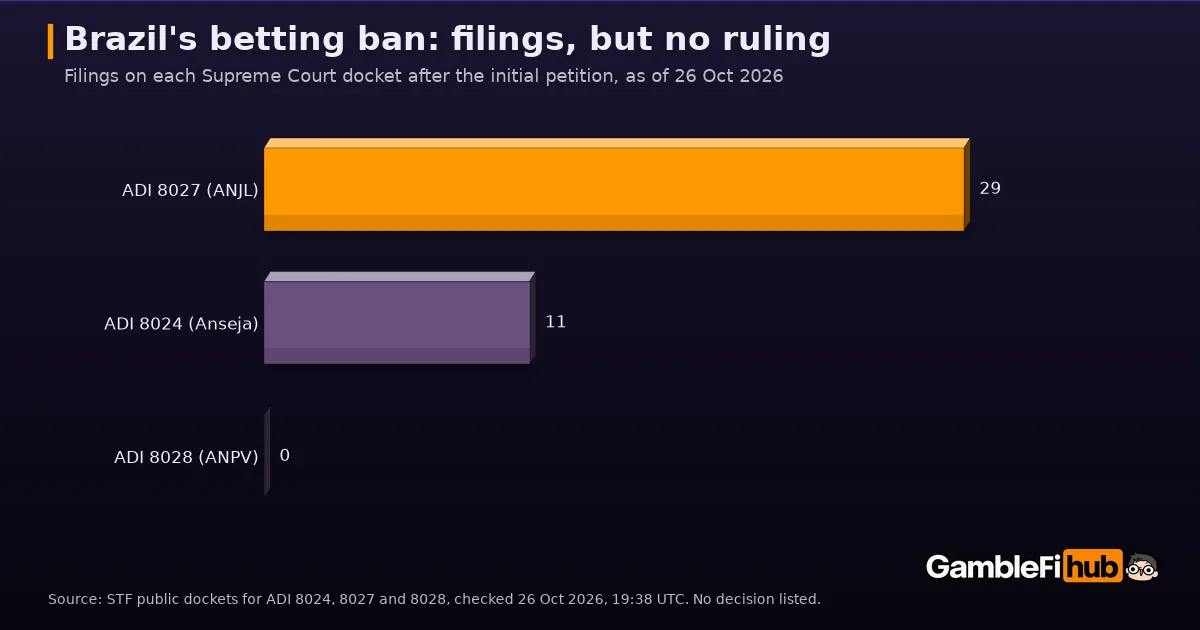
Three direct actions of unconstitutionality are pending, all assigned to Justice Luiz Fux because he already handles earlier related cases. We counted the entries on each public STF docket on the evening of 26 October:
ADI 8027, filed on 28 September by the National Association of Games and Lotteries (ANJL), has 29 filings: 22 requests to join as amicus curiae, five submissions from parties, one request for interim relief and one set of supplementary documents. A new submission arrived on 25 October.
ADI 8024, filed on 28 September by Anseja, a betting-law association, has 11: seven amicus requests, three submissions and one request for interim relief.
ADI 8028, filed on 29 September by ANPV, an association of mayors and deputy mayors, has no filings beyond the initial petition; it was assigned to Fux on 2 October.
On 26 October, the day after the run-off, both ADI 8024 and ADI 8027 were sent back to Fux for review. Neither docket lists a decision or an interim order. When we reported on Stake’s failed reprieve on 21 October, the picture was the same. Any ruling by Fux alone would also need to be confirmed by the full court.
The congressional clock
A provisional measure has the force of law at once but lapses unless Congress converts it. The Chamber of Deputies record sets the first period from 25 September to 23 November, says it has not yet been extended, and shows the measure starts blocking the agenda of the house reviewing it from 9 November. The Constitution allows one 60-day extension. The Chamber record lists no rapporteur yet.
Key facts
Run-off: 25 Oct 2026; Lula 51.79%, Flávio Bolsonaro 48.21% (TSE).
Ban: MP 1.394/2026 of 25 Sep 2026; authorisations extinguished 25 Oct 2026, no fee refund (art. 4).
Supreme Court: ADI 8024, 8027 and 8028, rapporteur Justice Luiz Fux; 40 filings in total, no decision as of 26 Oct 2026.
Congress: agenda lock from 9 Nov; first deadline 23 Nov, extendable once by 60 days.
Why it matters for GambleFi
The measure explicitly reaches operators based abroad, which includes offshore crypto casinos and iGaming token platforms with Brazilian users, and it cuts off local payment rails. Before the ban, a crypto-casino brand could hold a Brazilian licence, as Stake did. Our report on the refund wind-down covers what happened to player balances, and our GambleFi FAQ explains how these platforms work. This is a report on a law and court cases, not legal or betting advice.