
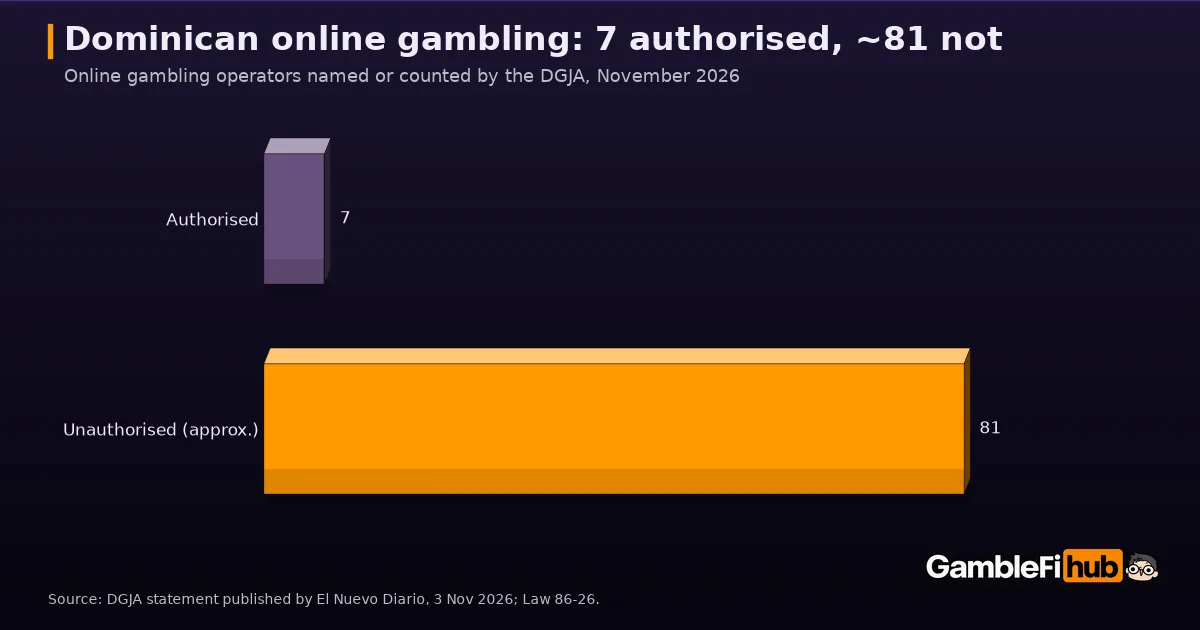
The Dominican Republic has drawn its first line under a new gambling law. Its Directorate General of Gambling (DGJA) said in a statement published by El Nuevo Diario that only seven online gambling operators appear as authorised on the finance ministry’s portal. It also said it has identified about 81 operators that take bets or run virtual games without state authorisation, and that it is weighing legal or administrative steps against them. It did not name the 81.
The list grants no new licences. The seven are operators already authorised on the ministry’s books, mostly local sportsbook brands on .do domains, and under the new law they too must re-qualify. Nobody else can get in for now: the Council of Gambling that has to set fees and conditions for new online licences has not met yet, the DGJA said.
What Law 86-26 changes
Law 86-26 was promulgated on 22 September 2026 (Chamber of Deputies record) and published in the Official Gazette on 2 October. It replaces the old Directorate of Casinos and Games of Chance with the DGJA, an autonomous body under the Ministry of Finance and Economy, led on a transitional basis by Teófilo Tabar Manzur under Decree 684-26.
For offshore sites the key clause is Article 79. It lets the DGJA order internet providers, through the telecoms regulator INDOTEL, to block unlicensed domains and apps, and to require payment companies to stop transactions to those operators. The DGJA must also publish and update both a list of authorised operators and a list of blocked sites. Article 82 requires online operators to check each player’s identity and age against the national electoral register before any deposit or bet, and to offer deposit, loss and session limits.
Existing licence holders, including online ones, get one year to re-qualify for a new licence under Article 181. Article 191 then freezes new licences for ten years once the register of licensees is published. That freeze is written for the categories in Article 21, which include internet and virtual gambling, though the text speaks of installing establishments and does not say how it applies online.
Key facts
Authorised online operators: 7, all pre-existing (DGJA statement, published 3 November 2026).
Operators flagged without authorisation: about 81, not named.
Internet gambling licence: 10 years (Art. 77); virtual games licence 5 years (Art. 96); fees and conditions still to be set by the Council (Art. 76, 97).
Tax: 10% a month on internet gaming operations (Art. 78); RD$5 million a month per company until the collection system is ready (Art. 186).
Penalties: one to two years in prison for operating without a licence (Art. 162); fines of 200 to 400 public-sector minimum wages for very serious infringements.
Law: 86-26, promulgated 22 September 2026, Official Gazette 11263 of 2 October 2026.
Why it matters for GambleFi
Crypto casinos and onchain betting sites that take Dominican players and are not among the seven have no licence there, and no way to apply for one yet. The new law gives the regulator two levers that hit them directly: domain blocking and orders to payment firms. The ID check against the electoral register before any deposit also rules out the no-KYC model many crypto casinos use. Prediction markets are already covered: in April the old directorate issued a public warning that platforms such as Polymarket, Kalshi and Criterio360, which take bets in cash or crypto, hold no Dominican licence.
The pattern matches other jurisdictions tightening around offshore and crypto-funded gambling, from Curaçao’s crypto rules to the dispute over Anjouan licences, while smaller hubs such as Nevis try to attract the same businesses. For iGaming tokens, the GambleFi coins issued by crypto casinos, every market that closes to unlicensed sites shrinks the audience their platforms can legally serve. Our licence check of 17 registers shows which token platforms hold any licence at all. This is a news summary, not legal advice. The GambleFi FAQ explains how crypto gambling is regulated.