
Malta’s shield for its online gaming licensees has survived its first trip to Luxembourg without being examined. On 19 November 2026 the Court of Justice of the European Union (CJEU) declared inadmissible a reference from the Handelsgericht Wien, Vienna’s commercial court, in case C-683/24, Spielerschutz Sigma. The Vienna court had asked whether Article 56A of Malta’s Gaming Act, the 2023 amendment known as Bill 55, is compatible with the EU regulation on recognising judgments across borders (Regulation 1215/2012, Brussels I bis). The court gave no answer on that question, so the provision stays on Malta’s statute book and Maltese courts keep applying it.
The dispute behind the case
According to the court’s press release, Spielerschutz Sigma Prozessfinanzierungs is a Vienna litigation funder that finances Austrian players’ claims against Malta-licensed operators which offered games in Austria without an Austrian licence. It has won numerous loss-refund judgments in Austria and tries to enforce them in Malta. Article 56A, inserted on 12 June 2023, treats such actions as contrary to Maltese public policy and tells Maltese courts to refuse recognition and enforcement of the resulting foreign judgments. The funder paid a German law firm €5,000 for an opinion, dated 5 July 2023, that the article clearly breached EU law and would not be applied. On 19 July 2023 the First Hall of the Civil Court in Malta refused one of its enforcement requests, citing Article 56A. The funder then sued the law firm in Vienna for the fee and for losses on cases it funded between 5 July and 1 August 2023.
Why the court said no
A preliminary reference is only admissible if the answer is needed to decide the case in front of the national court. The Fourth Chamber found that it was not. Under Austrian law, the Vienna court only has to decide whether the legal opinion was at least reasonably defensible when it was written, in light of the case law and legal writing available then. That does not depend on whether Article 56A is actually compatible with EU law, so the questions amounted to a request for an advisory opinion. Advocate General Nicholas Emiliou, whose opinion was delivered on 23 April 2026, had also treated the reference as inadmissible; the judgment records that he proposed answers on the substance only in the alternative, and Malta asked on 8 May 2026 to reopen the oral procedure in case the court went that way.
Key facts
Case: C-683/24, Spielerschutz Sigma Prozessfinanzierungs v Geissler Heilbock Hopf Ferox Legal; ECLI:EU:C:2026:992.
Court: CJEU Fourth Chamber, judgment of 19 November 2026; referred by the Handelsgericht Wien on 16 October 2024.
Result: reference inadmissible; no ruling on Article 56A or Brussels I bis.
Law at issue: Article 56A, Gaming Act (Chapter 583, Laws of Malta), in force since 12 June 2023.
Parallel track: European Commission letter of formal notice INFR(2025)2100, 18 June 2025.
Sources: CJEU press release 167/26 and judgment; European Commission infringement package; Malta Gaming Authority statement. Checked 23 November 2026.
Our numbers
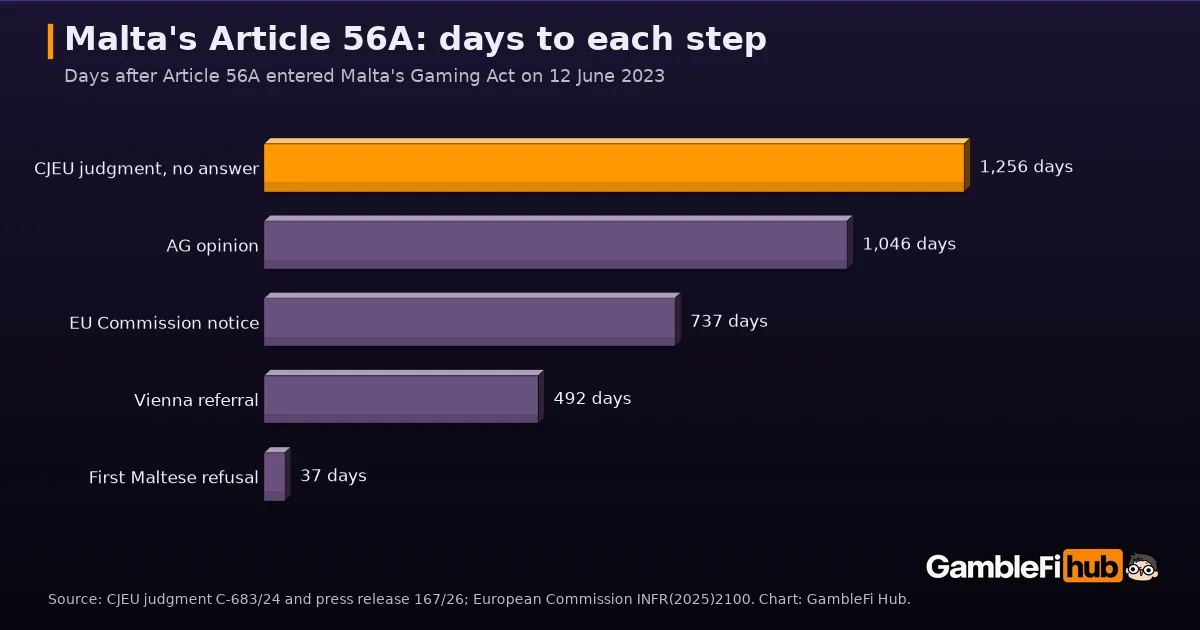
The judgment came 1,256 days after Article 56A took effect and 764 days after Vienna made its reference (see chart). In that time the only EU-level steps against the article are on the political track. The European Commission opened infringement proceedings on 18 June 2025, saying Malta forces its courts to refuse judgments from other member states systematically, exceeds the limits of the public policy exception and discourages foreign claimants from suing in Malta. Malta had two months to reply; the Commission’s next step would be a reasoned opinion. The Malta Gaming Authority answered the same day that Article 56A “does not impose a blanket ban” on enforcing European judgments against its licensees and only codifies Malta’s public policy on gaming.
What it means for iGaming token platforms
For players, the practical picture is unchanged: an Austrian refund judgment against an MGA licensee can still be refused in Malta, and the open question of whether that is lawful now waits for another case or for the Commission. Article 56A only covers holders of a Maltese licence. In our licence check of 17 iGaming token platforms, the current entries we found were in Anjouan, Curaçao and Tobique registers, not Malta, and Anjouan licences are themselves disputed by the Comoros government. Our reading, not the court’s: players of GambleFi and crypto casino platforms licensed outside the EU face a different problem, since Brussels I bis only governs judgments between EU member states, so collecting a refund there depends on the law of the licensing country. Before depositing, check which regulator a platform names and where its operating company sits. Our GambleFi explainer and FAQ cover the basics. This is a report on a court ruling, not legal or gambling advice.