
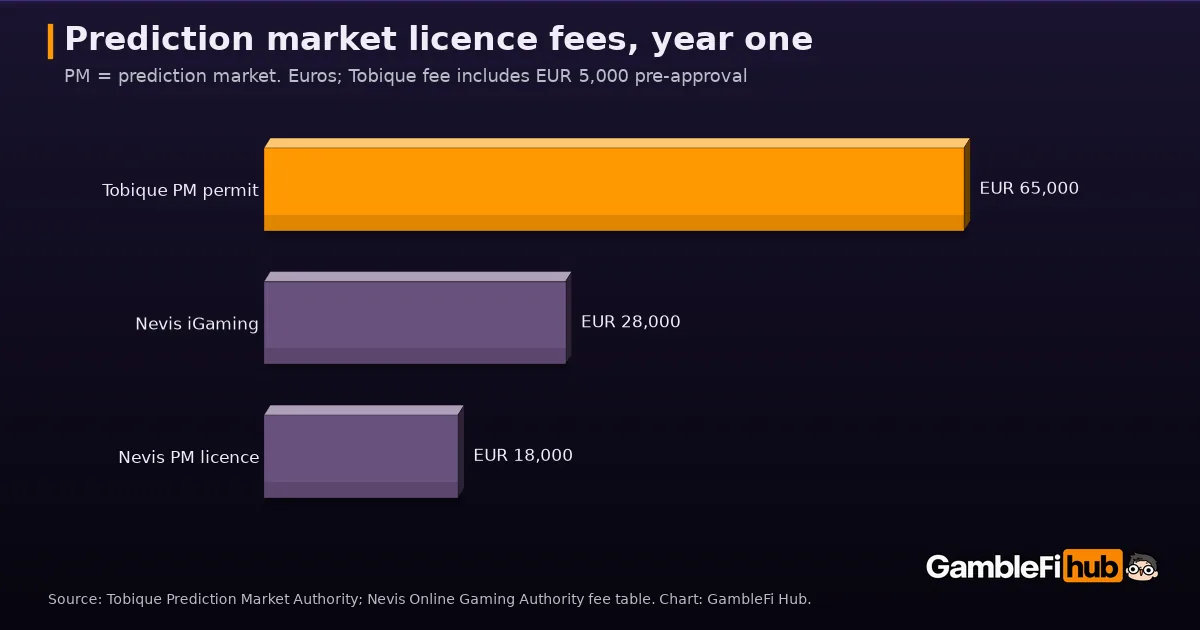
A second small licensing hub now sells a permit built only for prediction markets. The Tobique First Nation in New Brunswick, Canada, says it enacted the Tobique Prediction Markets Act on 22 October 2026 and set up the Tobique Prediction Market Authority (TPMA) as the sole regulator of permit holders. According to the TPMA’s fee page, a one-year Prediction Market Permit costs €65,000. That is 3.6 times the €18,000 that Nevis charges for its new prediction market licence, and more than double the Nevis iGaming licence (see chart).
What the permit covers
The TPMA’s framework page says an authorised event contract is regulated under Tobique law as market activity, “not as betting, gaming or a lottery”. The permit is separate from the gaming licences Tobique already issues under its Gaming Act 2023 and does not cover casino games, lotteries or fixed-odds bookmaking. Sports and esports markets are permitted. Entertainment, politics and economic indicators are permitted subject to conditions, with Tobique’s own elections excluded. Markets on disasters, conflict and loss of life, and on Tobique community affairs, are prohibited. Suppliers of material technology or services need a separate B2B Market Services Permit, per the requirements page.
Built for crypto
The regime is digital-asset only. The FAQ says permit holders must not receive, hold, transfer or settle fiat money for participants; conversion has to run through an approved external provider. Only TPMA-approved digital assets and stablecoins may be used, and assets with anonymity or obfuscation features are banned. Every operator must screen onchain deposits and withdrawals through the blockchain assurance provider the authority has approved, and pays volume-based fees for that monitoring on top of the permit fee. Order books, peer-to-peer, AMM, request-for-quote, principal and hybrid models can all be approved, but operators must disclose whether they match users, act as counterparty or hedge externally. Smart contracts and oracles used for trading or settlement must be tested, monitored and able to be paused or upgraded.
Key facts
Regulator: Tobique Prediction Market Authority (TPMA), Tobique First Nation, New Brunswick.
Law: Tobique Prediction Markets Act 2026, enacted 22 October 2026; General Compliance Regulations 2026.
Fee: €65,000 for one year, including a €5,000 pre-approval fee; plus volume-based monitoring fees.
Timeline: 4 to 8 weeks from a complete application; renewal filed at least 3 weeks before expiry.
Other rules: no local tax on prediction market revenue, no server location requirement, records kept for at least 7 years.
Sources: TPMA announcement, framework, permit requirements, cost page and FAQ; Nevis Online Gaming Authority fee table. Checked 23 November 2026.
Our numbers
On published fees, an operator pays €65,000 in year one in Tobique against €18,000 in Nevis, a gap of €47,000, before Tobique’s volume-based monitoring charges. Nevis keeps prediction markets €10,000 cheaper than its own iGaming licence; Tobique prices its permit at €37,000 more than the Nevis casino licence. Tobique offsets that elsewhere: its FAQ lists no local tax on prediction market revenue, while some US states are moving to tax the sector, as our Kentucky tax comparison shows. The TPMA says permit holders can serve participants worldwide “subject to the laws of each market they serve”. A law firm review by GME Law on 18 November noted that sports, entertainment and political event contracts remain off limits elsewhere in Canada, and that the Act and regulations had not yet been published. We could not find the full Act text on the TPMA site on 23 November either.
Why it matters for GambleFi
Onchain prediction markets and crypto sportsbooks have often relied on offshore gaming licences, or none at all. Tobique now offers a crypto-native permit that treats event contracts as market activity rather than betting, and it already licenses gaming: in our licence check of 17 iGaming token platforms, BetFury’s Canadian site was the one entry we found on Tobique’s gaming register. Our reading, not the authority’s: the price and the mandatory chain monitoring suit funded exchanges more than small token projects, and peer-to-peer venues such as SX Bet would still have to disclose how they match orders. A hub permit does not make a product legal in the US, the rest of Canada or other restricted markets. The GambleFi FAQ covers the basics. This is a report on a licensing regime, not legal or gambling advice.