
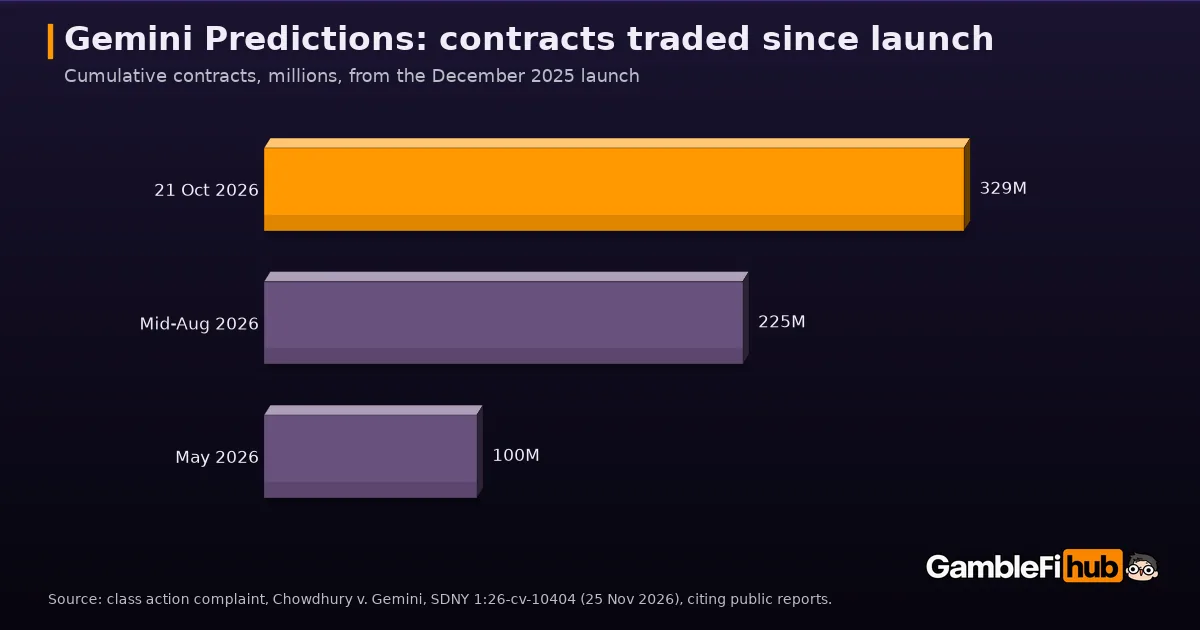
Gemini, the crypto exchange founded by Cameron and Tyler Winklevoss, faces a proposed nationwide class action over its prediction market. The complaint was filed on 25 November in the US District Court for the Southern District of New York (case 1:26-cv-10404). The plaintiff, Rayath Chowdhury, is a New York resident. He says he lost money on sports event contracts on Gemini Predictions from about 19 May 2026. His claim is that the product is an unlicensed sportsbook, not a financial market.
Who is sued and why
The defendants are Gemini Space Station, Inc., its exchange unit Gemini Titan, LLC, its clearing unit Gemini Olympus, LLC, Winklevoss Capital Fund, LLC and both twins personally. The complaint says no Gemini entity has ever held a licence from the New York State Gaming Commission. It argues that sports contracts on game winners, point spreads and multi-leg “combos” are bets, whatever the label.
The filing makes several further claims. Users aged 18 to 20 can trade, although New York sets 21 as the betting age. Gemini listed a market on a game between St. John’s and UConn, and New York bans bets on its own college teams. A “Taker Rate” of 0.07 is described as a 7% rake. Users face market makers that Gemini recruits and pays, not only each other. Users can fund trades with crypto held in their Gemini accounts, and the complaint says Gemini sets no deposit limits like those of licensed sportsbooks. None of this has been tested in court.
The legal theory
The five counts rest on New York law. Two come from old wager-recovery statutes: General Obligations Law § 5-419 lets a bettor recover stakes from the winner or stakeholder, and § 5-421 lets a person who lost $25 or more sue the winner within three months. The other three are deceptive practices and false advertising under General Business Law §§ 349 and 350, plus unjust enrichment. The plaintiff seeks class certification, an accounting of all bets, repayment of losses, damages including trebling, restitution, an injunction and attorneys’ fees.
The suit leans on actions by states. New York’s attorney general sued Gemini Titan in April 2026, Connecticut issued a cease-and-desist order in September and Ohio did the same in October. Gemini Titan is registered with the CFTC as a designated contract market. Exchanges in this position argue that federal law, not state gambling law, governs their contracts, an argument still being fought in New York over Kalshi and Novig.
Key facts
Case: Chowdhury v. Gemini Space Station, Inc., No. 1:26-cv-10404 (S.D.N.Y.), filed 25 November 2026, jury demanded.
Class: everyone in the US who spent money wagering on Gemini’s platforms, plus statewide subclasses.
Counts: N.Y. Gen. Oblig. Law §§ 5-419 and 5-421, N.Y. Gen. Bus. Law §§ 349 and 350, unjust enrichment.
Amount in controversy: alleged to exceed $5 million.
Status: complaint only; allegations not tested in court.
Source: complaint and docket on CourtListener (read 28 November 2026).
What it means
State attorneys general have been the main opponents of sports event contracts so far. This suit shows a second front: private plaintiffs using New York’s wager-recovery laws to claim back what users lost, and naming founders personally. For iGaming token (GambleFi) projects the point is the same. Parlay-style combos and market makers on the other side of retail orders are exactly what this complaint calls betting, and onchain books such as SX Bet have no CFTC registration to point to. Our GambleFi FAQ explains how prediction markets differ from crypto casinos. This is a report on a court filing, not legal or betting advice.