
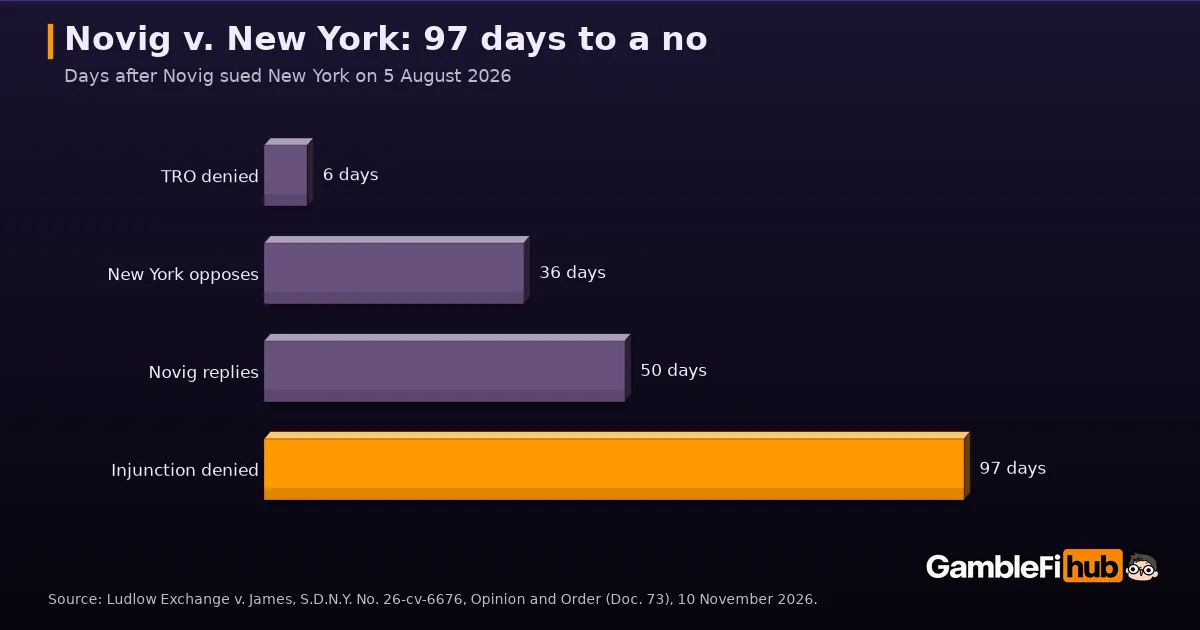
A federal judge in Manhattan has refused to stop New York from applying its gambling laws to Novig, and went further than any court in the state so far. In a 35-page Opinion and Order filed on 10 November 2026, Judge Colleen McMahon held that Novig’s sports event contracts are not “swaps” under the Commodity Exchange Act (CEA). If they are not swaps, the Commodity Futures Trading Commission (CFTC) has no exclusive jurisdiction over them, and New York can require Novig to get a state licence or stop listing them.
Not swaps, so no shield
Under the CEA, a swap depends on an event “associated with a potential financial, economic, or commercial consequence.” The court agreed that a game result is an event, as the Third and Sixth Circuits found, but held that it lacks that consequence. “Bettors are not hedging against the economic fallout from price fluctuations,” the opinion says. Novig had pointed to a hotel hedging against its local team’s early playoff exit, but the judge noted that it “offers only hypotheticals, not a single real-world example” and markets to “ordinary people who want to bet on sports games.”
The opinion also rejects the exchange model as a difference. Novig does not take the other side of trades; it matches users and charges a fee. Where the test is economic consequence, the court wrote, “who is on the other side of the bet is simply not a difference that makes a difference.” As an example of the product, it describes a four-game NFL underdog parlay listed on Novig at a 111.11x payout.
No deference to the CFTC
Novig relied on the CFTC’s interim final rule, which says sportsbook-style wagers are not swaps, issued alongside a proposal to treat event contracts as swaps. The judge called the two “inherently contradictory” and said the agency’s change of position “appears calculated to influence the outcome of the ongoing litigation.” She also found, in the alternative, that even if the contracts were swaps there would be no express, field or conflict preemption. A CFTC order of 11 August telling Kalshi to keep operating, which Novig cited, “smacks of a collusive effort between a regulator and regulatee,” the opinion says.
On Novig’s claim that it could not comply with both laws, the court was blunt: Novig could seek a New York licence, as it once held one in Colorado, and could geofence its New York users. Having found no likelihood of success, the judge denied the motion without reaching the other injunction factors.
Key facts
Case: Ludlow Exchange, LLC d/b/a Novig v. James, S.D.N.Y. No. 26-cv-6676 (CM).
Ruling: Opinion and Order denying a preliminary injunction, Doc. 73, filed 10 November 2026, 35 pages.
Judge: Colleen McMahon.
Earlier steps: suit filed 5 August 2026; temporary restraining order denied 11 August.
Exchange: CFTC-designated contract market since 16 June 2026; New York sports contracts since August.
Status: preliminary ruling only; the merits are still to be decided.
Why it matters for GambleFi
The ruling arrives as the Second Circuit has already refused Kalshi and Coinbase injunctions pending appeal, and a merits panel there is still to hear the issue. It is also a bad week for Novig: the CFTC has stayed its NBA and WNBA props, and Missouri has countersued it under federal gambling law. Other exchanges are still racing to court first, as in Arkansas. For crypto betting the point is simple: the federal licence is the only argument these exchanges have against state gambling law, and this court says it does not cover sports. Offshore crypto sportsbooks such as SX Bet have no licence to argue with at all. Casino-style products are already carved out of the CFTC’s reach. This is a news summary, not legal advice; the GambleFi FAQ explains how prediction markets differ from crypto casinos.