
Missouri has gone on the offence against a prediction market. On 9 November 2026, Attorney General Catherine Hanaway filed her answer and three counterclaims in the lawsuit that Novig brought against the state in October. Until now the state had only defended itself in these cases. Now it is asking a federal court in St. Louis to stop Novig from accepting money from Missouri residents at all.
The three counterclaims
The first and most unusual count relies on the Unlawful Internet Gambling Enforcement Act of 2006 (UIGEA), the federal law that blocks gambling businesses from accepting payments for bets that are illegal where they are placed. The filing says Missouri sports wagers placed with Novig are illegal because Novig has no licence from the Missouri Gaming Commission, so every deposit tied to them is a “restricted transaction”. It asks for a restraining order and injunctions under the act. The filing’s list of covered payments includes credit, bank transfers, checks and stablecoins.
The second count is under the Missouri Merchandising Practices Act, the state consumer law. Missouri says selling unlicensed sports wagering is an “unfair practice” and asks for restitution plus civil penalties of up to $1,000 per violation. The third count asks the court to declare Novig’s Missouri business a public nuisance under state common law, citing a 1937 Missouri Supreme Court case on gambling operations.
The answer itself denies Novig’s core argument, that the Commodity Exchange Act gives the Commodity Futures Trading Commission (CFTC) exclusive control over its sports event contracts. The counterclaims describe those contracts as “binary wager contracts”. None of this has been decided. These are the state’s allegations, and Novig has not yet responded to them in court.
Six letters, six lawsuits
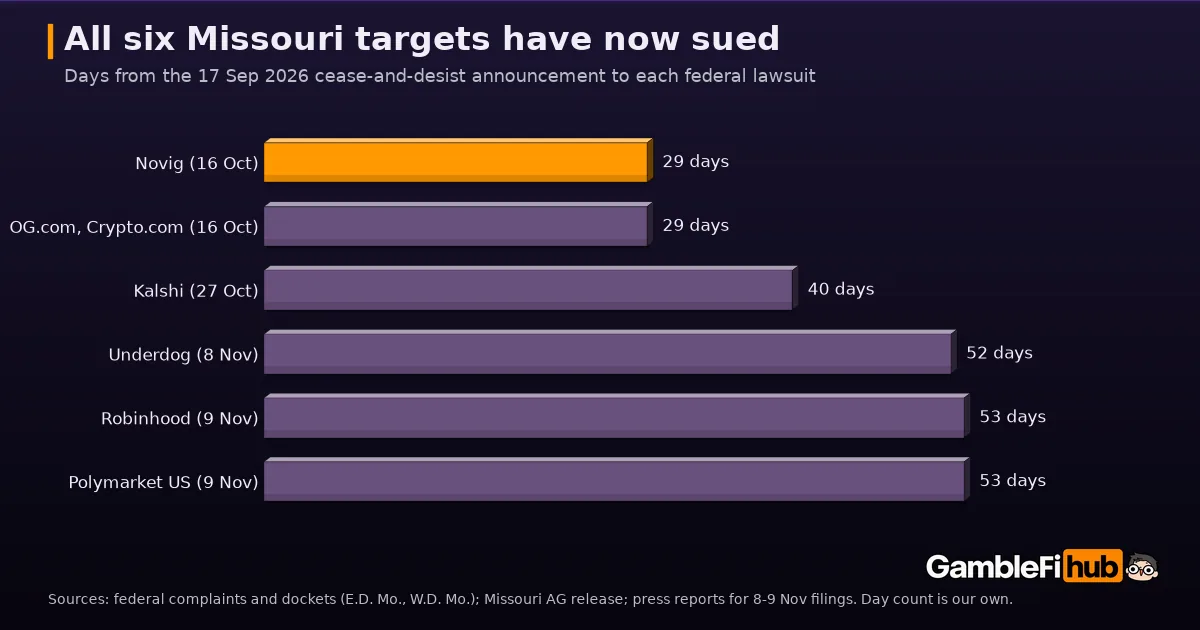
Hanaway announced cease-and-desist letters to six operators on 17 September. Novig and Crypto.com’s OG.com exchange sued first, on 16 October, and Kalshi followed on 27 October. Underdog sued on 8 November. On 9 November, the same day as the counterclaims, Robinhood and Polymarket US filed their own suits, according to RG.org and Gambling Insider. Gambling Insider reports that Robinhood’s complaint followed a 6 November warning from the state that it would seek a court order within three days. So every company that received a letter is now in federal court against Missouri.
Key facts
Case: Ludlow Exchange, LLC d/b/a Novig v. Hanaway, E.D. Mo. No. 4:26-cv-01780, Doc. 23, filed 9 November 2026.
Counterclaims: UIGEA (31 U.S.C. 5363 and 5365), Missouri Merchandising Practices Act, public nuisance.
Relief sought: injunctions, restitution, civil penalties of up to $1,000 per violation, costs.
Signed by: Solicitor General Louis J. Capozzi III for the attorney general.
Other Missouri suits: Kalshi, OG.com, Underdog, Robinhood, Polymarket US.
Sources: answer and counterclaims, Missouri AG, RG.org.
Why it matters for GambleFi
Most state fights with prediction markets so far have been about whether state gambling law applies at all. Missouri is now also going after the money flow, and it is doing so with a federal statute. If a court accepts that theory, the target is not only the exchange’s product but every deposit a Missouri user makes, and the filing names stablecoins among the payments it covers. That matters for onchain platforms too. Novig was already in trouble at the federal level, where the CFTC stayed its NBA and WNBA prop contracts in October. Meanwhile the CFTC is pushing exchanges the other way, telling them to drop state geoblocks within 30 days. Our earlier posts on Novig’s lawsuit and the OG.com case explain how the Missouri fight started.
For iGaming tokens, the GambleFi coins tied to onchain casinos and betting sites, the lesson is that a state can attack the payment side, not just the betting product. A platform that takes stablecoin deposits from users in a state where its bets are illegal could face the same kind of claim. This is a news summary, not legal or investment advice. The SX Bet project page covers an onchain betting exchange, and the GambleFi FAQ explains how crypto betting is regulated.