
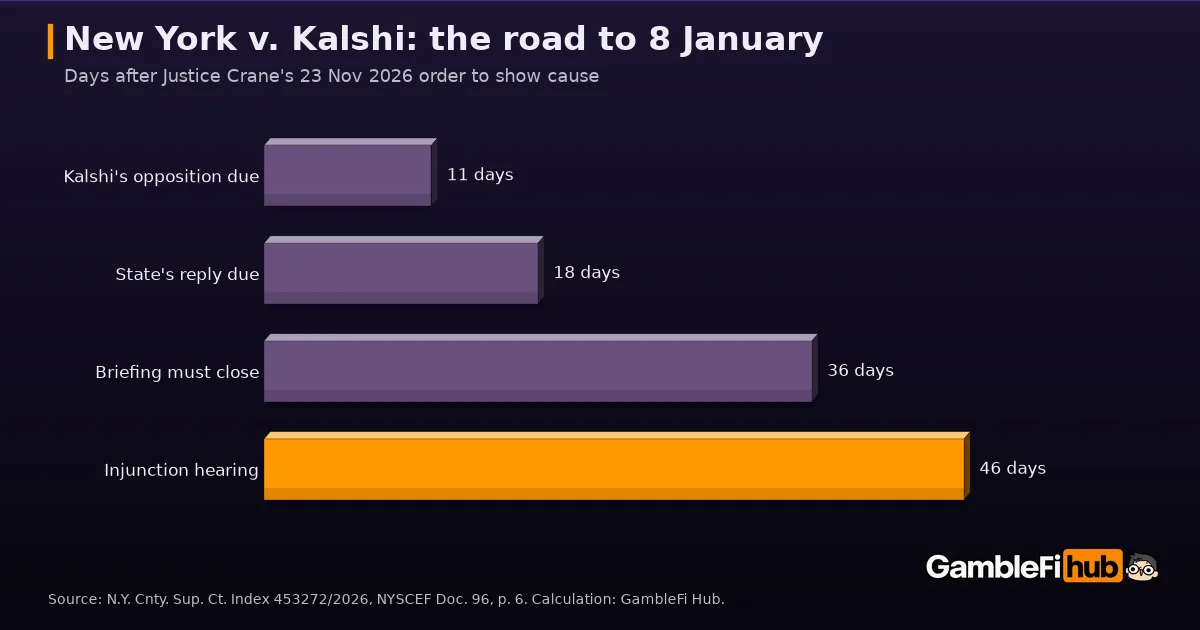
Kalshi keeps trading in New York at least into the new year. At a hearing on 23 November, Justice Melissa A. Crane of the Supreme Court of New York, New York County, declined Attorney General Letitia James’s request for a temporary restraining order (TRO) against the exchange. What she did sign was an order to show cause (NYSCEF Doc. 96, filed 24 November), which turns the dispute into a fully briefed preliminary-injunction motion. Oral argument is set for 8 January 2027 at 9:30 am in Manhattan (15:30 CET).
Forty-six days of briefing
The signed page of the order, dated 23 November, fills in the timetable by hand. Kalshi’s response is due by 4 December and the state’s reply by 11 December. A handwritten note lets the parties change those dates, as long as the motion is fully submitted by 29 December 2026. That gives both sides 46 days from the order to the hearing (see chart). Nothing in the schedule decides the core question: whether Kalshi’s sports contracts are unlicensed gambling under New York law, or swaps that only the CFTC may police.
Kalshi read the outcome narrowly too. “The judge denied the State’s request for a TRO, recognizing that there are complex questions about derivatives and preemption,” head of communications Elisabeth Diana said in a statement to SBC Americas, adding that the company wants a path forward for its 1.5 million customers.
Why the state asked for so much so early
The hearing came four days after a federal judge sent the case back to state court, as we covered in our earlier report. The state’s proposed order would have barred any unlicensed gambling business “within or from New York”. Kalshi is based in New York, and in the federal case it argued that the state wants to “shut down Kalshi’s exchange altogether, including in states other than New York,” as the remand opinion records. An emergency order of that reach, before Kalshi had filed its defence, was the step the court would not take.
The 18-to-20 question
Age is where the state’s case looks strongest. New York’s licensed sportsbooks may not take bets from anyone under 21; Kalshi accepts traders from 18. The New York City Council said on 24 November that Crane had flagged this as a particular concern at the hearing. The Council’s own figures, from data supplied by Kalshi, show about 51,000 of 484,000 city accounts belong to 18- to 20-year-olds, and that group took about $8.9 million, or 17%, of individual users’ net losses this year (our breakdown). Since late October, Kalshi has put those accounts on a default $2,500 monthly deposit limit and shows an alert when a new trader with more than $1,000 puts over 25% of the balance into one trade (details).
Key facts
Case: People of the State of New York v. KalshiEX LLC, Index No. 453272/2026, Supreme Court, New York County, Justice Melissa A. Crane.
Ruling: TRO request declined at the 23 November 2026 hearing; order to show cause signed 23 November, filed 24 November (NYSCEF Doc. 96).
Schedule: opposition 4 December, reply 11 December, fully submitted by 29 December 2026, oral argument 8 January 2027, 9:30 am.
Not decided: licensing, preemption and any limits for 18- to 20-year-olds.
Sources: signed order (p. 6, as posted by gaming lawyer Daniel Wallach), S.D.N.Y. remand opinion 26-cv-6550 Doc. 25, NYC Council release, Kalshi. Checked 26 November 2026.
What it means
Our reading, not the court’s: in New York neither side has won an emergency order. Federal judges twice refused the CFTC’s bid to stop the state, and now a state judge has refused the state’s bid to stop Kalshi, so the status quo holds until a full hearing. Higher up, the federal appeals courts lean towards the states: the Second Circuit refused Kalshi an injunction pending appeal, and the Fourth Circuit sided with Maryland. If New York wins in January, it would be a licensing ruling in Kalshi’s home state, on top of the proposed 10% fee tax in Albany. For iGaming token (GambleFi) platforms, the lesson is that states attack on age and licensing first, and a federal label does not settle either. Our GambleFi explainer and FAQ cover the basics. This is a news report, not legal advice.