
New York has a new proposal for prediction markets, and it does not try to ban them. Senate Bill S.10748, introduced by State Senator Jeremy Cooney on 23 November 2026 and committed to the Senate Rules Committee, would tax operators 10% of their net trading fee revenue from New York residents and put the money into universal pre-kindergarten. Its official name spells that out: the “Fairness, User Transparency, Universal Pre-kindergarten, and Responsible Exchange Safeguards Act”, or FUTURES Act. It is a bill, not law: it has not passed either chamber.
What the bill would tax
The tax sits in a new Article 15 of the Tax Law. It applies to “net trading fee revenue”: trade-execution fees and commissions, minus payments to brokers, data providers and market makers, promotions and rebates, clearing fees, withdrawal fees and compliance costs such as KYC and anti-money-laundering checks. Only trades by residents who are in New York at the time count, and the tax article defines an event contract as one based on sports. Returns would be filed quarterly. The bill text calls the levy “solely a revenue measure” that imposes no licence or market-access requirement, and it states that a CFTC-registered prediction market may operate in New York lawfully because of that federal registration.
The money would go to a new “futures fund for early education” that pays school districts for 2-K, 3-K and 4-K. The bill also earmarks, without adding a new tax, the share of existing personal income and corporate franchise tax that comes from prediction-market gains. The tax department would certify that amount each year from 1 December 2029.
The consumer rules
Most of the bill text is a new consumer-protection article in the General Business Law, enforced by the attorney general. Operators would have to verify identity and age, with the minimum age left to the CFTC. Each would keep its own self-exclusion list with a one-year minimum, honour exclusions from state lists, stop marketing to an excluded customer within 48 hours and refund balances within ten business days. Customers would get deposit limits, cooling-off periods and activity statements, and limit changes would take effect within 24 hours. Operators would have to flag these tools to anyone who deposits more than $100,000 in a day or trades more than $1 million in 45 days.
Adverts could not target minors or call a trade “free” or “risk-free”, and affiliates would be bound by the same rules. Withdrawals would have to be processed within five business days. Trading on material nonpublic information would be a misdemeanour, and state and local elected officials and senior policymaking staff could not trade event contracts at all, an angle on the insider-trading worries around the sector. Using a prediction market to further an election crime would become a felony. Civil penalties would reach $25,000 per violation, or $100,000 if wilful. Throughout, the bill says federal law wins: where a rule conflicts with the Commodity Exchange Act, CFTC or NFA rules, the federal rule controls.
Key facts
Bill: New York Senate S.10748 (FUTURES Act), sponsor Sen. Jeremy Cooney; introduced 23 November 2026; committed to the Rules Committee.
Tax: 10% of net trading fee revenue from sports event contracts traded by residents present in the state; quarterly returns.
Fund: futures fund for early education (State Finance Law § 99-uu), universal pre-K.
Consumer rules: one-year minimum self-exclusion; 48-hour marketing stop; 24-hour limit changes; five-business-day withdrawals; five-year record keeping.
Penalties: up to $25,000 per violation, $100,000 if wilful; insider trading a misdemeanour.
Start: 180 days after enactment; attorney general rules need a 60-day comment period.
Sources: NY Senate bill page and bill text (PDF). Checked 26 November 2026.
Our numbers
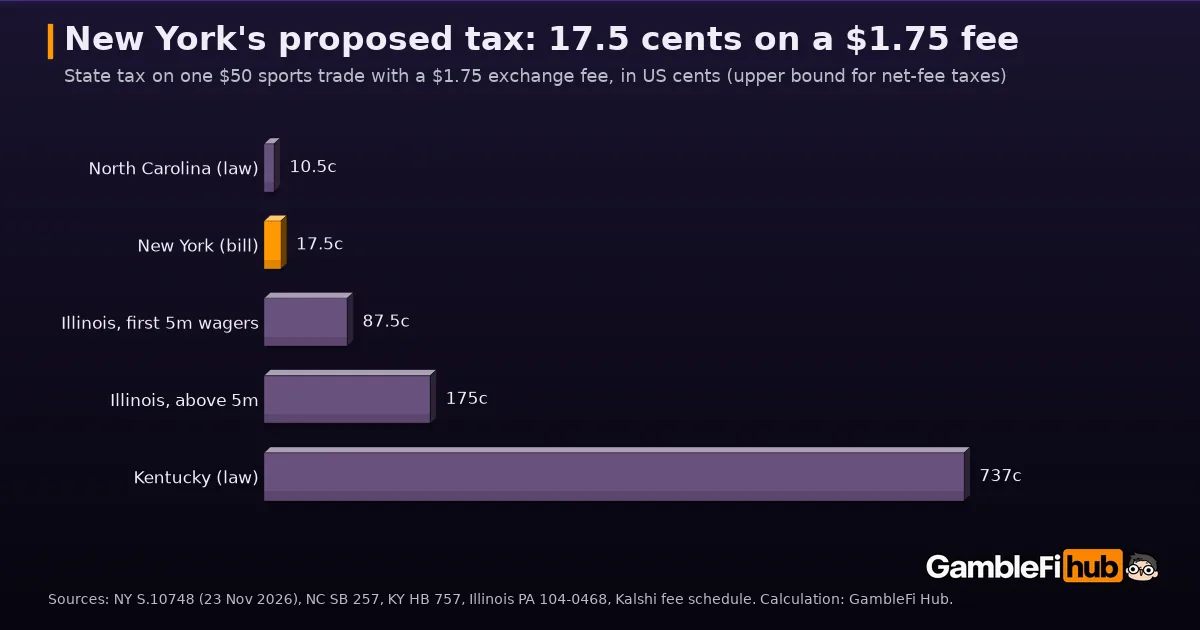
The tax base copies North Carolina’s design almost line by line: net trading fee revenue, sports contracts only, residents present in the state, the same deductions. Only the rate is higher, 10% against 6%. Using the same example as our state tax comparison, one sports trade of 100 contracts at 50 cents costs $50 and, at Kalshi’s taker rate (see our fee comparison), carries a $1.75 fee. New York’s tax on it would be at most 17.5 cents, against about 10.5 cents in North Carolina. Illinois takes 87.5 cents or $1.75 per wager, and Kentucky $7.37 (see chart). In other words, New York would take a tenth of the fee. Kentucky takes more than four times the fee. The bill gives no revenue estimate, so we do not offer one.
What it means for iGaming token platforms
New York is now on two tracks. Its attorney general is fighting Kalshi in state court, while this bill would accept federal oversight and tax and police the business instead. That is the opposite of Utah’s approach, and it fits the CFTC’s new reporting rule, which already asks exchanges for trader identities. Our reading, not a legislator’s: the bill covers any platform that serves New York consumers “whether or not” it is a registered exchange, but it grants legal status only to CFTC-registered markets. Offshore onchain prediction markets and iGaming token (GambleFi) platforms such as SX Bet gain nothing from it. The legislature’s two-year term ends in December, so the bill may need to be filed again in 2027 to move. Our GambleFi explainer and FAQ cover the basics. This is a news report, not legal or tax advice.