
Austria is about to open its online gambling market, and the bill sets a hard deadline for operators that have served Austrians without a local licence. On 24 November 2026 the Finance Committee of the Nationalrat passed the amendment to the Gambling Act and the Telecommunications Act (government bill 594 d.B.) with the votes of the ÖVP, SPÖ and NEOS. The FPÖ and the Greens voted against. It is still a bill, not law: the full Nationalrat and the Bundesrat have not voted on it.
From monopoly to open licences
Today, online casino games in Austria are tied to the single federal lottery concession. The bill splits them off. The gambling authority could grant an unlimited number of online gambling concessions. Each would run for at most five years at first, and up to ten years on renewal. Applicants would need at least €10 million in paid-up capital, down from €109 million under the current lottery rules. The gambling tax on online games stays at 45% of gross gaming revenue. Concessions could be granted from 1 January 2027 and would take effect from 1 October 2027.
The exit deadline and the brand rule
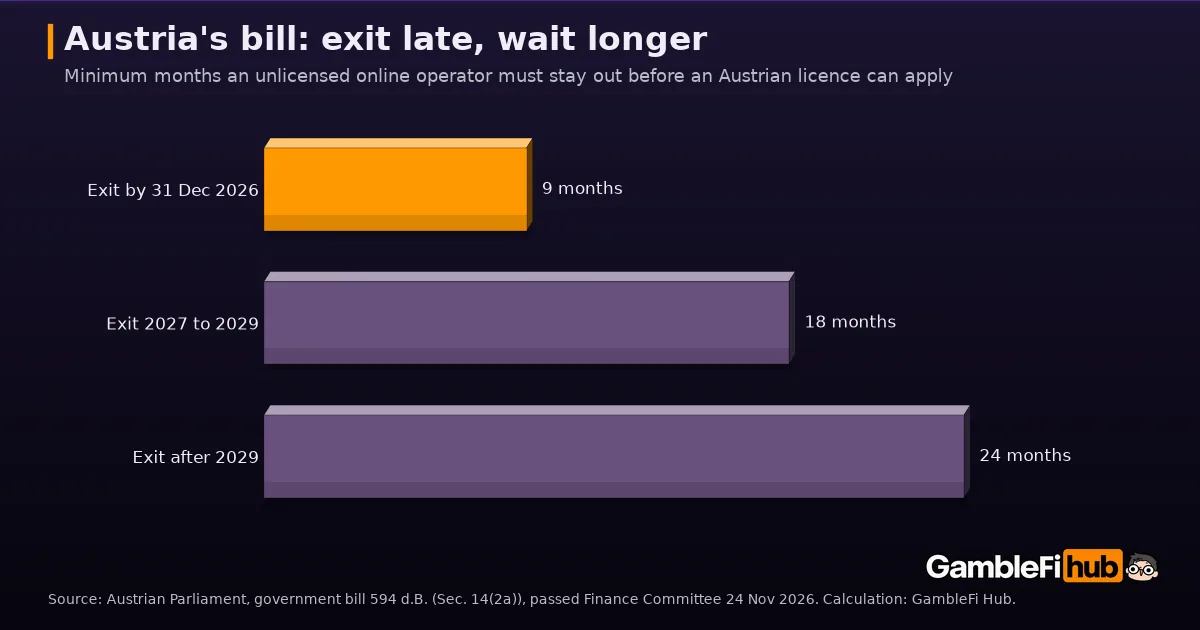
The key clause is for operators that are serving Austria right now. Under the bill, having run illegal online gambling does not by itself rule a company out. It must meet three conditions. First, it must pay all gambling tax due and not yet time-barred. Second, it must pay every final Austrian court judgment won by players, the so-called player-protection claims. Third, it must stop serving Austria from 1 January 2027 until it gets its concession. An operator that stops later is barred for 18 months from the day it stops, or 24 months if it stops after 2029 (see chart). The rules reach group companies up to the beneficial owner. They also cover brands that are only slightly changed. Applicants must sign a compliance declaration, and the authority would publish their names and brands.
The judgment rule matters beyond Austria. Austrian players, often backed by litigation funders, have won numerous loss-refund judgments against Malta-licensed operators. Malta’s Bill 55 lets its courts refuse to enforce those judgments, and the EU’s top court left that shield untested. Under this bill, an operator that wants an Austrian licence would have to pay those judgments anyway.
Blocking, payment stops and player limits
Enforcement gets new tools. The Telekom-Control-Kommission could order internet providers to block illegal sites, with fines of up to €1 million if a provider does not comply. Unlicensed operators would go on a public blacklist. Banks and payment firms would have three banking days to stop handling payments once notified, an approach like the one Australia is taking. The fine for offering illegal online gambling would go up to €1 million. Licensed players would get a cross-operator register and a deposit cap: €250 a week for under-26s and €1,680 a month for older players, unless extra monitoring is in place. Raising a self-set limit would take 72 hours to apply. A central exclusion register and a new office for gambling and player protection are also planned. For land-based slot machines, the committee release lists a €5 maximum stake per game, at least two seconds per game and a 15-minute break every 90 minutes.
Key facts
Bill: Austrian Gambling Act and Telecommunications Act amendment, government bill 594 d.B.; committee report 743 d.B.
Status: passed the Nationalrat Finance Committee on 24 November 2026 (ÖVP, SPÖ, NEOS for; FPÖ, Greens against); plenary and Bundesrat votes pending.
Licences: unlimited number; at most 5 years first, up to 10 on renewal; €10 million minimum capital; granted from 1 January 2027, valid from 1 October 2027.
Exit rule: stop serving Austria by 31 December 2026, or face an 18-month bar (24 months after 2029); unpaid gambling tax and player judgments must be settled.
Tax: 45% of gross gaming revenue on online games (unchanged).
Enforcement: ISP blocking, blacklist, payment stops within 3 banking days, fines up to €1 million.
Sources: Austrian Parliament press release PK 1127 and bill text 594 d.B. Checked 26 November 2026.
What it means for iGaming token platforms
Our reading, not the ministry’s: this is the first clear test for crypto casinos that accept Austrian players. In our licence check of 17 iGaming token (GambleFi) platforms, ten had a current entry in the Curaçao, Anjouan or Tobique registers, seven of them in Anjouan. None of those licences counts in Austria. Some of them are still sorting out their home licences, such as Rollbit, whose Curaçao licence is under appeal, while Curaçao has its own crypto rules coming. The payment-stop clause names banks and payment firms. The bill text does not mention crypto at all, unlike Australia’s guidance, which counts digital currency as funds. Wallet-to-wallet deposits look outside its direct reach. Blocking orders and the blacklist still apply, and Sweden’s Duel case shows that blocks are only as good as their enforcement. For any operator hoping to get an Austrian licence, 31 December 2026 is the date that counts. Our GambleFi explainer and FAQ cover the basics. This is a news report, not legal advice.