
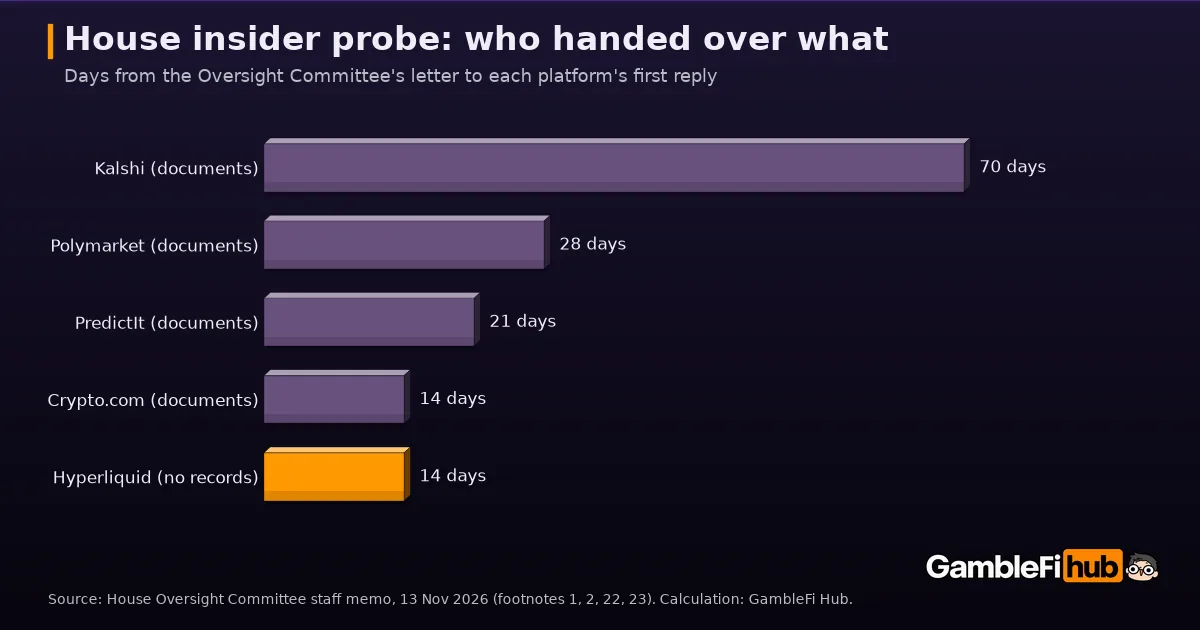
The House Oversight Committee’s probe into insider trading on prediction markets now has a written result, and one platform stands apart. A staff memorandum to the committee’s majority members, dated 13 November 2026 and released by Chairman James Comer, says four of the five platforms it questioned sent substantial documents or briefed staff on how they catch insiders. The fifth, Hyperliquid, told the committee it did not “possess the types of records and information” requested about its identity checks and Know-Your-Customer (KYC) procedures.
Five platforms, two rounds of letters
The inquiry began on 22 May 2026 with letters to Kalshi and Polymarket. On 29 September it was widened to Hyperliquid Labs, Crypto.com and Aristotle Exchange, the parent of PredictIt. The letter to Hyperliquid asked for its KYC rules, how it keeps US users out, the cost of those checks versus growth, and its tools for flagging suspicious trades, with a deadline of 13 October. Over the whole inquiry the committee received nearly 1,700 pages and five bipartisan staff briefings.
The memo’s footnotes date each first reply (see chart). Crypto.com sent documents on the 13 October deadline and PredictIt a week later, on 20 October. Hyperliquid’s reply also came on 13 October, as a letter from its law firm, Latham & Watkins, not a document set. In the first round, Polymarket’s first production arrived on 19 June and Kalshi’s on 31 July.
What the memo says the law already covers
The staff view is that current insider-trading law already reaches event contracts. The CFTC’s anti-fraud Rule 180.1 is modelled on the SEC’s Rule 10b-5. The Commodity Exchange Act, as amended by the 2012 STOCK Act, bars federal employees, Members of Congress, their staff and judicial officers from trading on nonpublic information from their jobs, or tipping others who trade. The memo says most known insider cases were first caught and reported by the platforms themselves. It lists a CFTC complaint alleging that a Google engineer made $1.2 million on Polymarket.com using nonpublic search data, a $35,000 order against former congressman George Santos, and a $172,000 order against a White House teleprompter operator over Kalshi mention markets. It also describes Polymarket’s “PolyGraph” surveillance system, built with Chainalysis.
The recommendation goes further than enforcement. Staff say Congress should consider barring federal personnel, Members and congressional staff from some event contracts even without inside information, at minimum contracts on government actions and political outcomes. That would extend the Senate’s April 2026 ban on senators and their staff and the Pentagon memo on service members. It is a staff recommendation, not a bill.
Key facts
Document: House Committee on Oversight and Government Reform, majority staff memorandum, 13 November 2026.
Platforms asked: Kalshi and Polymarket (22 May 2026); Hyperliquid Labs, Crypto.com, PredictIt via Aristotle Exchange (29 September 2026).
Material received: nearly 1,700 pages and five bipartisan briefings.
Hyperliquid: said through counsel on 13 October that it did not hold the KYC and identity records requested.
Recommendation: Congress should consider limits on event-contract trading by federal personnel, Members and staff.
Sources: committee press release, staff memo and the 29 September letter to Hyperliquid. Checked 26 November 2026.
What it means for onchain markets
Our reading, not the committee’s: the memo draws a clear line between platforms with an identity layer and one without. Kalshi and Polymarket US can tie a suspicious trade to a verified person and refer it to the CFTC, as in the candidate cases. Hyperliquid is fully onchain, so every trade is public, but by its own account it holds no identity file to hand over. The memo itself cites media reports of a large leveraged short on Hyperliquid placed shortly before a tariff announcement. That gap matters more now that Hyperliquid’s outcome markets are growing. The memo also notes that Polymarket.com, the offshore, non-CFTC exchange, blocks US users, but that VPNs may let some get through. For iGaming token (GambleFi) platforms that settle bets onchain, the message from Washington is that public trade data does not replace knowing who the trader is. The CFTC’s new event-contract reporting rule points the same way. Earlier letters from Congress, such as the VIP-perks inquiry, focused on VIP rewards, not identity. Our GambleFi explainer and FAQ cover the basics. This is a news report, not legal advice.