
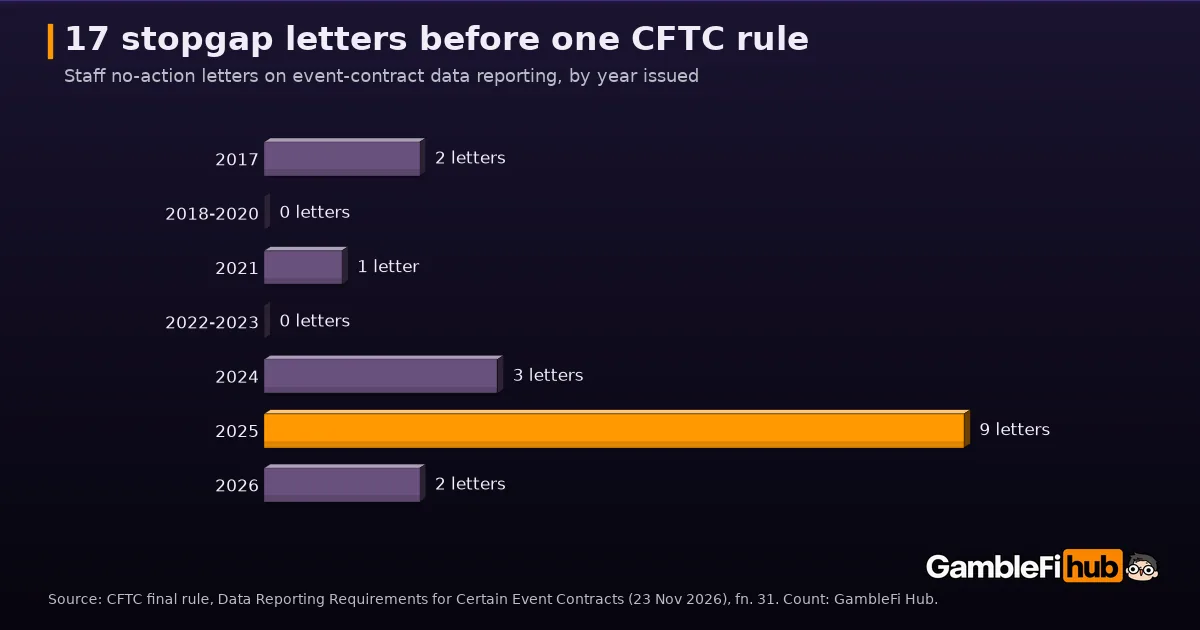
The Commodity Futures Trading Commission approved a final rule on 23 November 2026 that gives prediction-market exchanges a permanent data-reporting regime. Until now, event contracts on exchanges such as Kalshi have been exempted from swap reporting one exchange at a time, through staff no-action letters dating back to 2017. The final rule adds a new section, § 16.03 “Covered Event Contracts”, that moves these contracts onto the futures-and-options reporting rules instead. Chairman Michael S. Selig called the old letters “band-aids for unworkable regulations” in the CFTC announcement.
What changes for exchanges
A contract counts as a Covered Event Contract when it meets four tests. It must be a swap under the first two prongs of the statutory definition. It must be listed on a designated contract market (DCM) and cleared by a derivatives clearing organization. It must be fully collateralised. And it must have either a binary payout or a variable payout where only one side ends up profiting. Those contracts no longer go to swap data repositories under Parts 43 and 45. Instead the exchange sends daily trade data to the CFTC and falls under large-trader reporting, just as futures do.
Three requirements matter most for users. First, every exchange must post a public tape of each trade (time, ticker, quantity and USD price) as soon as technologically practicable, free of charge and kept online for at least a year. Second, it must record and publish how each contract settled: whether the event happened, when, and which source decided it. Third, it must collect each trader’s name, address, email, phone number, occupation and employer, plus anyone who guarantees the account or holds a stake of 10% or more, and keep that for five years after the contract ends. The CFTC’s Division of Data published a guidebook alongside the rule that sets the format for trader and settlement data. The rule also says its definition is for reporting only and does not define “event contract” for any other purpose, so it does not settle the separate swap-definition proposal.
Key facts
Rule: Data Reporting Requirements for Certain Event Contracts; amends Parts 15, 16 and 17; new § 16.03. Approved 23 November 2026 (CFTC release 9330-26).
Proposal: 1 July 2026 (91 FR 40102); comments closed 31 July; 28 substantive comment letters.
Large-trader level: 125,000 contracts for $1 event contracts, about $125,000 notional.
Compliance: core reporting, settlement data and public tape 60 days after Federal Register publication; large-trader and volume reporting the later of that date or 26 July 2027; trader-ID collection 12 months after publication.
Letters replaced: 17 staff no-action letters; the CFTC expects staff to withdraw most of them once the rule applies.
Sources: CFTC press release and final-rule text. Checked 25 November 2026.
Our numbers
We counted the letters listed in the rule’s footnotes by year (see chart): two in 2017, one in 2021, three in 2024, nine in 2025 and two in 2026. So 12 of the 17, about 70%, came after the start of 2025. That matches the listing boom the CFTC itself describes. DCMs listed about five event contracts a year from 2006 to 2020, 131 in 2021, and about 1,600 in 2025, roughly 320 times the old yearly average. From proposal to final rule took 145 days. The large-trader part cannot apply before 26 July 2027, 245 days after approval, so the public tape and settlement records will arrive well before position reporting does.
What it means for prediction markets and iGaming tokens
For exchanges, it means one rulebook instead of a letter each, which lowers the cost for newer venues such as Sporttrade. For users and researchers, a free trade tape and a named settlement source for every regulated contract are new. Today, disputes on onchain markets are argued in public through oracle votes, as our UMA dispute analysis showed. The trader-ID rule also gives the CFTC a direct view of who trades, relevant to the age questions in the NYC Council data. It does nothing about where people trade, the issue in the tribal court fights. Venues that are not DCMs, including offshore crypto books and onchain sportsbooks like SX Bet, are outside the rule. Our GambleFi explainer and the FAQ explain how iGaming token platforms differ from CFTC-regulated exchanges. This is a summary of a rule, not legal or trading advice.