
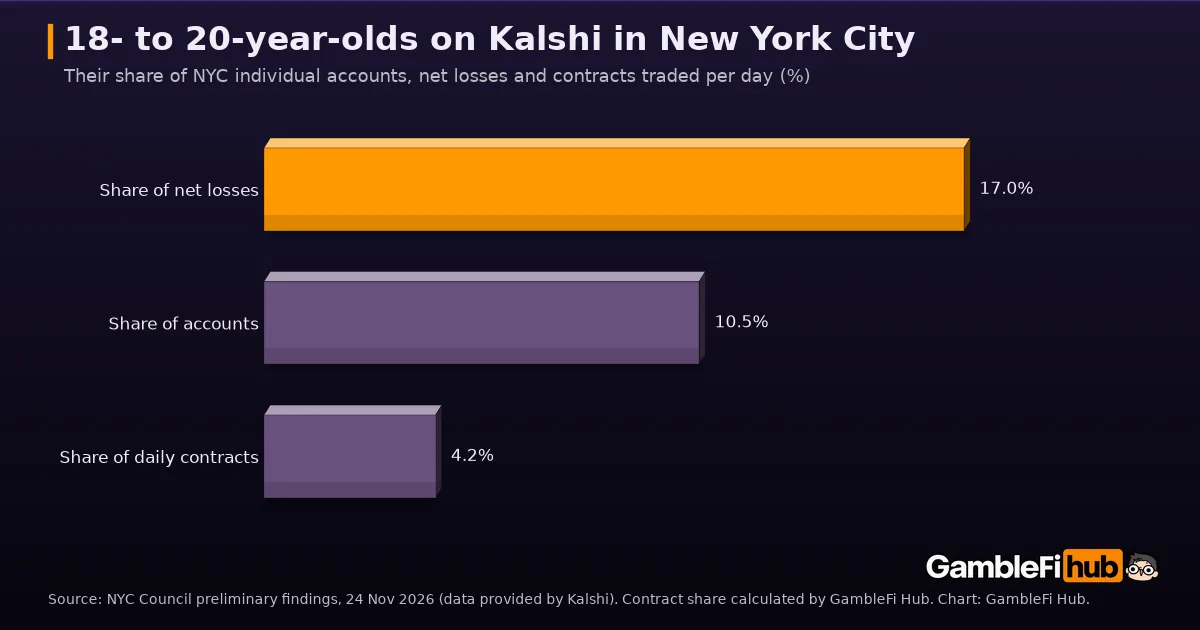
The New York City Council has published the first results of its inquiry into how prediction markets advertise. In a press release on 24 November 2026, Speaker Julie Menin set out figures that Kalshi gave to Council investigators. Individual Kalshi users with a New York City address lost about $52.5 million, in aggregate, between 1 January and 1 November 2026. About $8.9 million of that was lost by users aged 18 to 20. Institutional accounts in the city went the other way: they gained more than $210 million up to 11 August and a further $130.7 million up to 1 November. Three Council committees will hold a joint oversight hearing on Monday, 14 December, and Menin has asked executives from Kalshi, Polymarket, Coinbase, Gemini Titan and Novig to testify.
What the Council found
According to the Council, about 484,000 individual Kalshi accounts were linked to New York City addresses as of 1 November 2026. About 51,000 of them (10.5%) belonged to users aged 18 to 20, and another 78,600 to users aged 21 to 24. The 18-to-20 group took about 17% of all individual net losses but traded only about 1.3 million contracts a day, against about 30 million a day for users aged 21 and older. Losses also sped up in the second half: individual users lost about $17.6 million from 1 January to 11 August, then about $34.9 million from 12 August to 1 November.
The release also covers Polymarket. Company representatives told investigators that a user-generated content programme, run from January to June 2026, used social media ads with a mock trading website that showed made-up profits and account activity. The Council says the programme aimed to create “buzz” among younger people, was run by a 19-year-old and four interns, and paid creators between $20 and a few hundred dollars per video, plus $50 per referral. Polymarket’s representatives said the guidelines were not always followed and that they could not say who built the mock site. In a sample of prediction market ads, investigators also found sign-up, deposit and first-trade bonuses and ads tied to sports leagues, teams and media partners.
Key facts
Who: New York City Council, Speaker Julie Menin; Committees on Consumer and Worker Protection, Oversight and Investigations, and Mental Health and Substance Use.
What: preliminary findings of a legislative inquiry into prediction market marketing, first announced in August 2026.
Kalshi NYC accounts: about 484,000 individual accounts (1 November 2026); about 51,000 aged 18–20 and 78,600 aged 21–24.
Individual net losses: about $52.5 million from 1 January to 1 November 2026, of which about $8.9 million by users aged 18–20.
Institutional net gains: more than $210 million (1 January–11 August) and $130.7 million (12 August–1 November).
Next step: joint oversight hearing on 14 December 2026 on the findings and on proposed rules for prediction market marketing.
Source: NYC Council press release, 24 November 2026; data as provided by Kalshi and Polymarket representatives. Checked 24 November 2026.
Our numbers
Our own calculations from the Council’s figures, not the Council’s: counting both end dates, the first period covers 223 days and the second 82 days. That puts individual net losses at about $79,000 a day before 12 August and about $426,000 a day after it, around 5.4 times faster. Per account, users aged 18 to 20 lost about $175 on average, against about $101 for all other individual accounts, roughly 1.7 times as much. These are rough averages: account counts are a 1 November snapshot, while the losses cover ten months. On volume, 1.3 million of about 31.3 million daily contracts is a 4.2% share (see chart). The institutional gains and individual losses should not be netted against each other, because the other side of a New York trade need not be in New York.
What it means for prediction market users
The figures add to the pressure Kalshi already faces over young users. In late October Kalshi set a default $2,500 monthly deposit limit for 18- to 20-year-olds, which the Council notes, and Arkansas has sued Kalshi over sign-ups by 18-year-olds. New York State’s attorney general is running her own cases, covered in New York’s Kalshi case back in state court, and Kalshi has just paused trading in Utah. The Council’s point on aggregate results is worth noting for anyone trading event contracts: in this data, individual accounts lost money in both periods while institutional accounts gained. In our experience, onchain prediction markets and iGaming token platforms rarely publish this kind of split, so do not assume you are trading against other casual users. Our GambleFi explainer and FAQ cover the basics. This is a news report, not legal or gambling advice.