
Kalshi has stepped back from Utah on its own decision. The prediction market told The Salt Lake Tribune on 23 November 2026 that it had “made the difficult decision” to pause operations in the state. Utah account holders can no longer open new contracts. They can still exit positions they already hold and withdraw their funds, spokesperson Jacki McGavick said. Users in the state now see a message that “some markets are unavailable in Utah.” Kalshi put the number of affected people at “more than 177,000 Utahns who use Kalshi” and said it looks forward to returning “once our legal position is vindicated.”
Why Kalshi stepped back now
In a statement quoted by KUTV, Kalshi gave two reasons: “the adverse final judgment in federal court” and the federal court “not yet having granted the CFTC’s emergency request to enjoin Utah’s enforcement actions.” The first is Kalshi’s own case. Kalshi sued Utah in February, and on 4 August 2026 Judge Robert J. Shelby ruled that the state can enforce its gambling laws against Kalshi’s event contracts. The Tenth Circuit refused in September to block enforcement while Kalshi appeals. Utah then filed a civil suit against Kalshi and Susquehanna on 20 October and criminal charges against Kalshi and its two founders on 28 October.
The second reason is the federal government’s case. The CFTC sued Utah on 26 October and asked for a temporary restraining order and a preliminary injunction on 29 October, according to the court docket (case 2:26-cv-01055). Shelby merged it with a similar suit by Crypto.com’s US derivatives exchange (North American Derivatives Exchange) and heard only the restraining-order request on 20 November. No ruling had been entered on the docket by the time Kalshi paused. At the hearing, FOX 13 reported, Shelby said gambling regulation “sits squarely within the police powers of the state” and that the CFTC may have “a steep hill to climb” to persuade him otherwise. A lawyer for Utah told the court that Utah is about 1% of Kalshi’s total market, so blocking the state by geofencing would be easy.
Key facts
What: Kalshi paused its operations in Utah on 23 November 2026: no new contracts; closing positions and withdrawals still allowed.
Who is affected: “more than 177,000” Utah users, according to Kalshi.
Kalshi’s own case: final judgment for Utah on 4 August 2026; appeal pending at the Tenth Circuit.
Federal case: United States and CFTC v. State of Utah, D. Utah 2:26-cv-01055, consolidated with 2:26-cv-01056; restraining-order hearing 20 November 2026, no ruling yet.
State cases: civil suit Brown v. Kalshi (No. 260908356, filed 20 October 2026); criminal informations of 28 October 2026 (14 counts); the founders’ initial appearance is set for 4 December, SBC Americas reported.
Sources: Salt Lake Tribune, KUTV, FOX 13, CourtListener docket, our earlier coverage. Checked 24 November 2026.
Our numbers
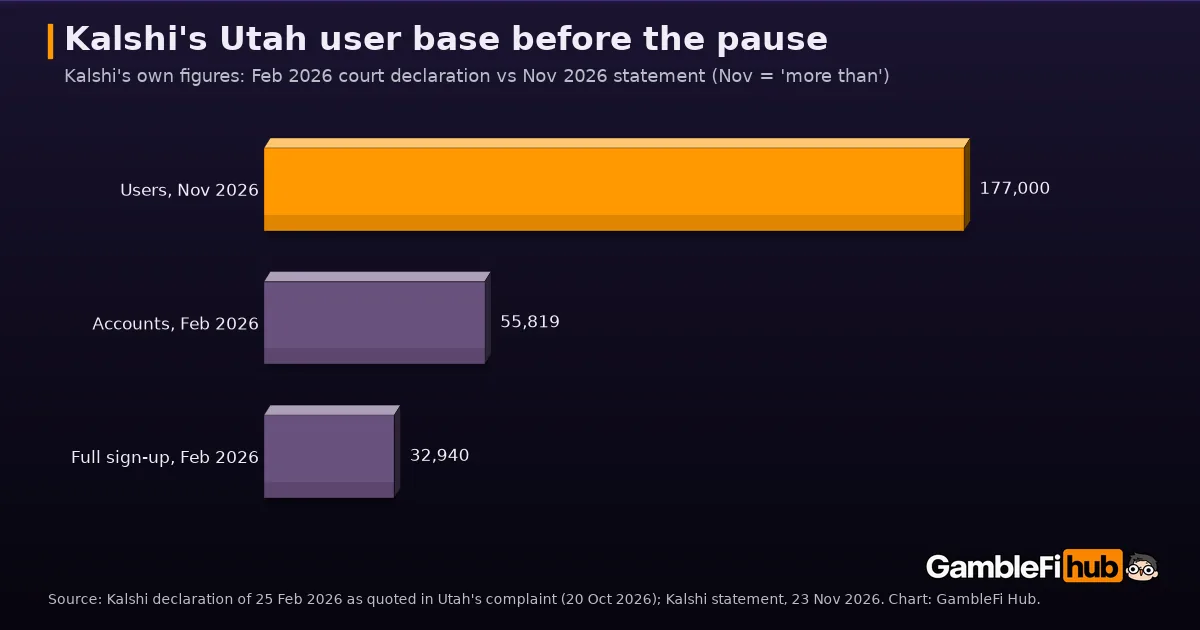
Kalshi’s Utah base grew fast while the fight went on. A declaration from Kalshi’s head of markets dated 25 February 2026, quoted in Utah’s civil complaint, put Utah accounts at 55,819, of which 32,940 had fully completed sign-up. Nine months later Kalshi speaks of more than 177,000 Utah users, about 3.2 times the February account count (see chart). The two figures are not measured in the same way, so this is a rough guide, not exact growth. The pause comes 273 days after Kalshi sued Utah on 23 February and three days after the hearing on the CFTC’s request. It also came on the day a New York state judge declined, for now, to bar Kalshi, CoinDesk reported, in the case we covered in New York’s Kalshi case back in state court. In federal appeals, the states lead 3–1 after the Fourth Circuit’s Maryland ruling.
What it means for iGaming token platforms
The pause shows what a state ban looks like in practice for users: positions can be closed and money taken out, but new trades stop. Utah’s attorney general did not need a new court order for that; the pressure of a lost federal case, a civil suit and criminal charges was enough. Our reading, not a court’s: onchain betting and prediction products, such as the one on our SX Bet project page, sit even further from that federal shield, because a platform without CFTC registration cannot rely on the preemption argument Kalshi is making. If a platform you use operates in a state that is suing prediction markets, check its terms on geoblocking and withdrawals before you deposit. Our GambleFi explainer and FAQ cover the basics. This is a news report, not legal or gambling advice.