
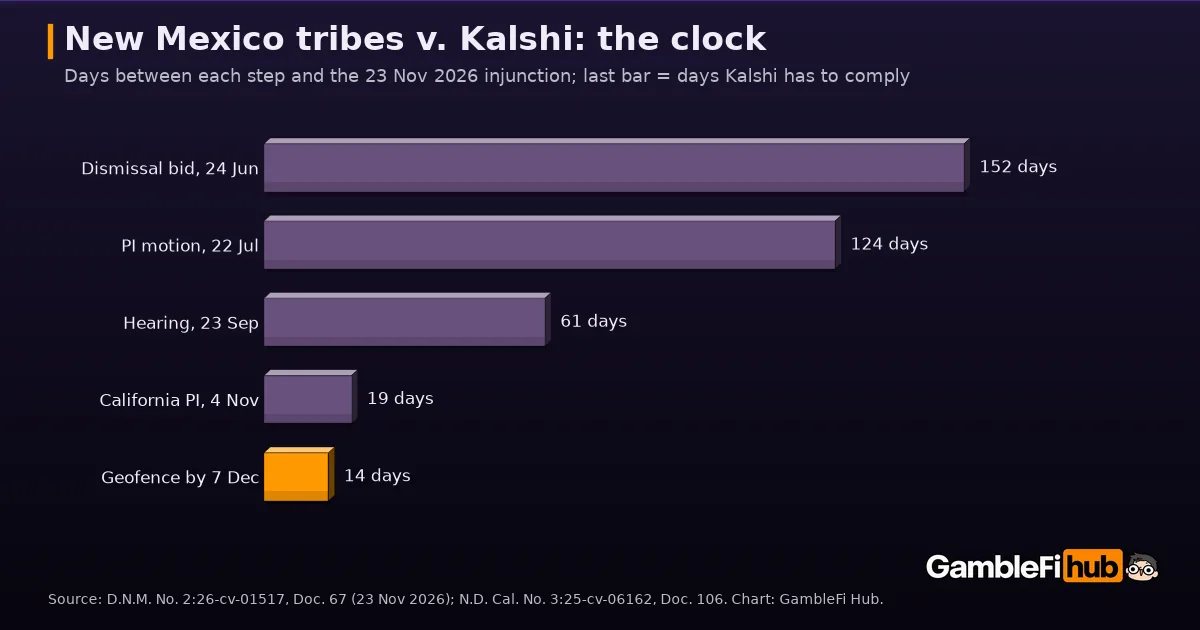
U.S. District Judge Margaret I. Strickland granted a preliminary injunction against Kalshi on 23 November 2026 and denied the company’s motion to dismiss. The 29-page order in Mescalero Apache Tribe v. Kalshi, Inc. (D.N.M. No. 2:26-cv-01517) bars Kalshi Inc., KalshiEX and their affiliates from offering internet-based sports betting or sports event contracts to people located on the Indian lands of the Mescalero Apache Tribe and the Pueblos of Isleta, Pojoaque and Sandia while the case runs. Kalshi has 14 days, until 7 December, to comply by geofencing or another method. Contracts entered before the order are not unwound.
What the court held
The four tribes sued under the Indian Gaming Regulatory Act (IGRA). Each operates gaming under a 2015-form compact with New Mexico, and their gaming laws ban third-party mobile sports betting on their lands. Kalshi argued that the Commodity Exchange Act (CEA) gives the CFTC exclusive jurisdiction over contracts traded on its exchange and that it cannot be bound by compacts it never signed. Strickland disagreed on both points. She found that a bet placed from tribal land is placed where the bettor is, even online, that Kalshi’s sports event contracts qualify as class III gaming under IGRA, and that the CEA does not “preempt or displace” IGRA or the tribes’ power to enforce their gaming rules. She followed the Ninth Circuit’s reasoning in the California tribal case and its Nevada ruling, and noted that the Third Circuit had sided with Kalshi.
On the balance of harms, the court said it “does not appear to be a heavy lift” for Kalshi to geofence the four tribes’ lands, since it already restricts access elsewhere. Kalshi had also warned that location blocks could clash with the CFTC’s impartial-access principles; the court still found all four injunction factors favoured the tribes. It required no bond. A Kalshi spokesperson declined to comment, Source NM reported.
Key facts
Court: U.S. District Court for the District of New Mexico, Judge Margaret I. Strickland; No. 2:26-cv-01517, Doc. 67, filed 23 November 2026 (order PDF).
Plaintiffs: Mescalero Apache Tribe, Pueblo of Isleta, Pueblo of Pojoaque, Pueblo of Sandia.
Order: motion to dismiss denied; preliminary injunction granted for sports contracts offered on the four tribes’ Indian lands only.
Deadline: 14 days to comply (7 December 2026); existing contracts not unwound; no bond.
Earlier steps: dismissal motion 24 June, injunction motion 22 July, oral argument 23 September 2026.
Sources: D.N.M. order via GovInfo; Source NM, 24 November 2026. Checked 25 November 2026.
Our numbers
Our own calculations from the court record: the ruling came 152 days after Kalshi’s dismissal motion and 61 days after oral argument (see chart). It landed 19 days after the California tribal injunction of 4 November, so two federal courts in two circuits have now blocked Kalshi sports contracts on tribal land in under three weeks. The New Mexico order is also tighter: California set a 21-day window for a compliance status report, New Mexico gives 14 days to actually comply. The 7 December deadline falls two days after the 5 December end of the CFTC’s 30-day window for exchanges to drop domestic geoblocks, so Kalshi faces a federal push to remove location limits and a court order to add one in the same week. As a sense of scale, IT staff at the three pueblos counted about 30,000 visits to Kalshi’s website over three weeks on their Wi-Fi networks, per Source NM, or roughly 1,400 a day. Those are visits, not wagers.
What it means for prediction markets and iGaming tokens
The order is limited to four tribes’ lands and does not decide whether Kalshi’s sports contracts are lawful elsewhere in New Mexico. But it adds to a pattern: Kalshi paused Utah itself this week, and appeals courts remain split, as our Fourth Circuit Maryland report showed. For prediction markets and crypto venues with sports products, including onchain books like SX Bet, the lesson is that a federal licence does not settle tribal gaming law. Our GambleFi explainer and the FAQ cover how iGaming token platforms differ from regulated exchanges. This is a report on a court order, not legal or betting advice.