
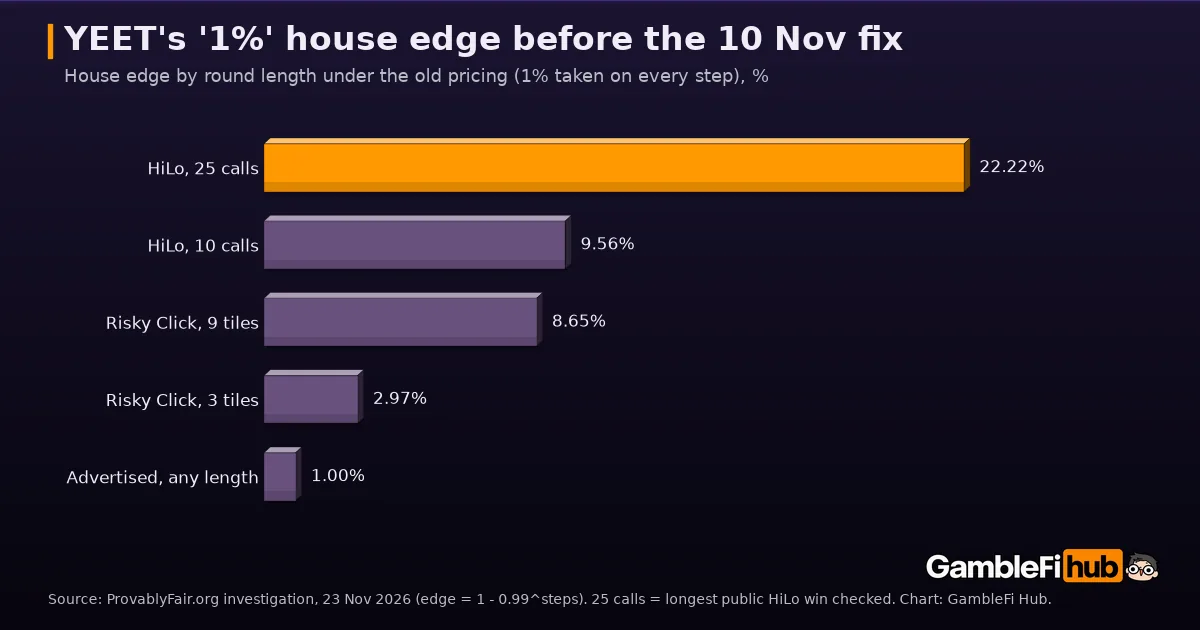
Crypto casino YEET advertised a “99% Return to Player” and a “1% House Edge” on two of its in-house games, HiLo and Risky Click. An investigation by ProvablyFair.org, published on 23 November 2026, found that until 10 November the games took that 1% again on every winning step instead of once per round. The longer a player kept going before cashing out, the bigger the real edge: 8.65% on a full nine-tile Risky Click board and 22.22% on a 25-call HiLo win, the longest public win the investigators found. YEET has since admitted the error and says refunds to active accounts have been paid.
What the investigators found
In both games a player places one bet and then plays in steps: flipping tiles in Risky Click, calling higher or lower in HiLo, with the option to cash out after each win. Every step multiplier already had 1% taken off, and the old pricing multiplied those step multipliers together, so the 1% was charged once per step. ProvablyFair.org checked the top ten wins from each of YEET’s public leaderboards for both games, 40 wins in total, and all 40 matched the per-step pricing, including all 163 HiLo calls. On 10 November YEET switched both games to charge 1% once per round; all 17 wins the team captured on 23 November used the new pricing. By then it had found no announcement and no refund notice. The data and scripts are in a public GitHub repository.
Every round still passed its provably-fair check. That check proves the random draw was not changed after the bet; it does not prove that the payout matches the advertised odds. The investigators say so directly: their work checks how wins were priced, not the draws.
What YEET says
In a first statement on 24 November, YEET said it fixed the “compounding RTP vs static” issue two weeks earlier and that the games “didn’t deviate from advertised RTP with any statistical significance”. Later that day co-founder Ben Lamb posted a longer account, which YEET quoted with “We messed up. It’s been rectified.” Lamb said the issue was found early in November, that the two games make up less than 1% of volume on YEET’s original games and less than 0.3% site-wide, and that refunds were delayed by data on a retired game server and by bot attacks. He also said YEET recalculated every win of two or more steps up to 10 November, that refunds to active accounts were issued with emails stating the amount, and that self-excluded users must send a wallet address for manual payment. YEET has not published a refund total or the number of accounts paid, and these figures have not been independently audited.
Key facts
Games: YEET’s in-house HiLo and Risky Click.
Advertised: 99% RTP, 1% house edge (game pages, 6 November 2026).
Old pricing: 1% on every step until 10 November; up to 8.65% (Risky Click, 9 tiles) and 22.22% (HiLo, 25 calls). The 38.89% HiLo figure is a 49-call model, which Lamb says no player reached.
Sample gap: $39,789.55 across the 40 selected public wins; ProvablyFair.org says this is not a total of player losses.
YEET’s figures: realised RTP 97.82% on HiLo and 98.34% on Risky Click; 99.69% and 100.03% after refunds.
Sources: ProvablyFair.org, 23 November 2026; statements by YEET and Ben Lamb on X, 24 November 2026. Checked 25 November 2026.
Our numbers
Our own calculations, not YEET’s or the investigators’: on the old pricing the edge on a round of n steps is 1 − 0.99n, so a 25-call HiLo win carried about 22 times the advertised edge (see chart). ProvablyFair.org’s example puts this in money: a $10 full Risky Click board paid $3,611.79 instead of $3,914.18, or $302.39 (7.7%) less. Taking YEET’s own realised RTP figures, the effective edge before refunds was 2.18% on HiLo and 1.66% on Risky Click, about 2.2 and 1.7 times the advertised 1%. That is far below the worst cases, because most rounds end after a few steps, but it is still above the number on the game page.
What it means for players and iGaming token communities
The case is about transparency as much as maths. The fix came quietly on 10 November, and refunds and a public explanation followed only after an outside report. It follows the BC.Game video poker shuffle case weeks earlier, and it echoes a pattern we saw in BC.Game’s CrashX fee: a 1% that is charged more than once is not a 1% edge. Lamb says YEET will publish its testing methods and simulations and pay bounties for discrepancies “in the coming months”. For players at any crypto casino, and for holders of iGaming tokens whose value depends on platform revenue and trust, the lesson is that a provably-fair badge does not cover payout tables. Our game mechanics FAQ, the GambleFi explainer and the FAQ cover the basics. This is a news report, not a recommendation of any operator.