
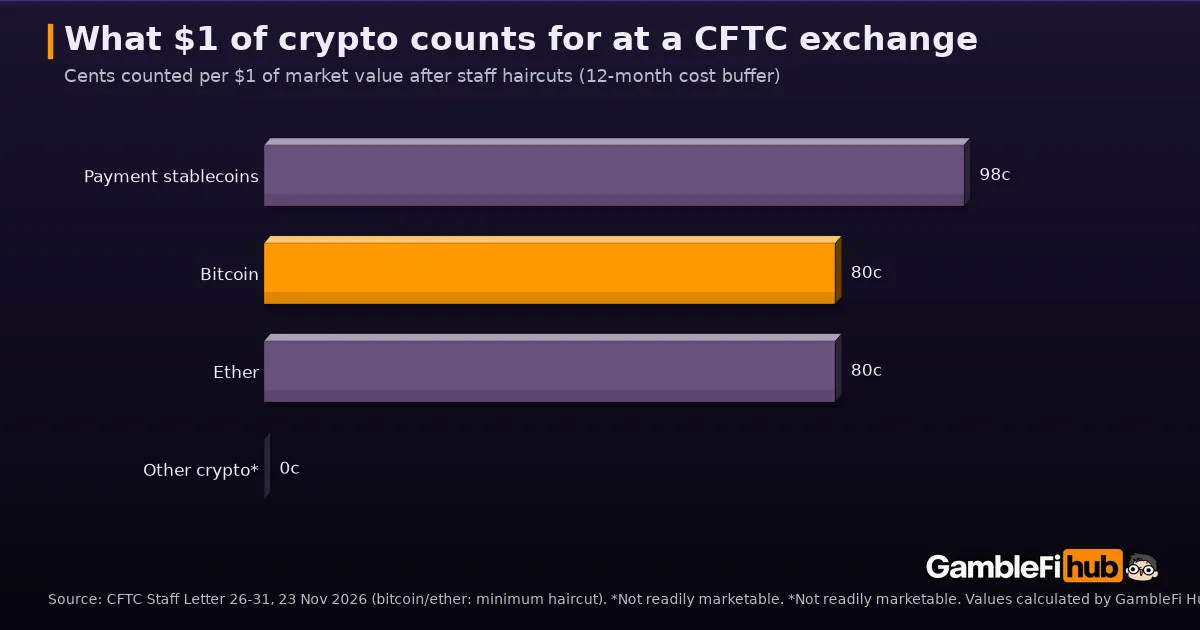
Two divisions of the US Commodity Futures Trading Commission have told the exchanges and clearing houses they supervise that crypto can now help them meet one of their basic capital tests. In CFTC Staff Letter 26-31, published on 23 November 2026 and announced in a CFTC press release, the Division of Market Oversight and the Division of Clearing and Risk say bitcoin, ether and payment stablecoins may count toward the financial resources that swap execution facilities (SEFs), designated contract markets (DCMs) and derivatives clearing organizations (DCOs) must hold to cover at least one year of operating costs. The assets must be marked to market and cut by a haircut first, and they cannot fill the separate cash-and-securities slice of that buffer.
What the advisory says
Every CFTC-registered exchange and clearing house has to show it could keep running for a year on its own resources. Staff say several registered entities, and some applicants, already hold crypto and asked whether it counts. The answer: yes for bitcoin, ether and payment stablecoins, subject to haircuts. Staff “would not object” to the levels already accepted for futures brokers’ own crypto positions: a minimum 20% haircut on bitcoin and ether and 2% on payment stablecoins. Any other crypto that is not readily marketable and is not a payment stablecoin “would generally require a 100% haircut”, which means it counts for nothing. Firms are also told to think about wrong-way risk, the case where an operating loss and a crypto price drop hit at the same time.
The limit is the liquidity rule. Part of each buffer must be “cash and/or highly liquid securities”: at least three months of operating costs for a SEF and at least six months for a DCM or DCO. Staff say crypto, including payment stablecoins, is neither cash under US accounting rules (GAAP) nor a highly liquid security, so it cannot be used there. Before the GENIUS Act takes effect, the letter treats a dollar stablecoin as a “payment stablecoin” only if a state-regulated money transmitter, a state trust company or a national trust bank issues it, its reserves sit in cash, Treasuries or overnight Treasury repos, and it publishes monthly reserve attestations.
Key facts
Who: CFTC Division of Market Oversight (Acting Director Duncan Hennes) and Division of Clearing and Risk (Acting Director Richard Haynes).
What: Staff Letter 26-31, an advisory on using crypto assets for the financial resources requirements in Regulations 37.1301, 38.1101(a) and 39.11(a)(2).
Assets covered: bitcoin, ether and payment stablecoins; other assets need direct talks with staff.
Haircuts: at least 20% for bitcoin and ether, 2% for payment stablecoins, generally 100% for other crypto that is not readily marketable.
Not eligible: the liquid slice (three months of costs for SEFs, six months for DCMs and DCOs) and a DCO’s default resources.
Status: staff views only; not a rule, not a no-action position and not necessarily the Commission’s view.
Source: CFTC Staff Letter 26-31 and press release 9331-26, 23 November 2026. Checked 24 November 2026.
Our numbers
Our own calculations from the letter, not the CFTC’s: after haircuts, $1 of bitcoin or ether counts for at most 80 cents, $1 of a payment stablecoin for 98 cents, and other illiquid tokens for nothing (see chart). Because the cash slice is six of the twelve months at a DCM or DCO, crypto can cover at most half of the 12-month buffer there, and at most three quarters at a SEF. Take an exchange with $12 million of yearly operating costs: at least $6 million must stay in cash or liquid securities, and filling the other $6 million with bitcoin would take at least $7.5 million of it at market value, or about $6.12 million of payment stablecoins.
What it means for prediction market and iGaming token users
Prediction market venues such as Kalshi are DCMs, so the advisory covers the exchanges where event contracts trade, alongside newer venues like Sporttrade and tZERO. It follows earlier staff steps on crypto as margin collateral, a trend covered in our report on Kalshi perps and bitcoin loans as margin. The haircut table is a useful reminder for anyone in iGaming tokens: platform tokens of casinos and onchain betting projects, such as the token of SX Bet, are not on the staff list at all. An exchange would have to clear them with staff first, and if they are not readily marketable they count for nothing. Even bitcoin loses at least a fifth. Customer money is not touched by the letter; it only concerns the exchange’s own operating buffer. Pressure on the same venues continues elsewhere, for example the NYC Council’s findings on young Kalshi users. Our GambleFi explainer and FAQ cover the basics. This is a news report, not legal or investment advice.