
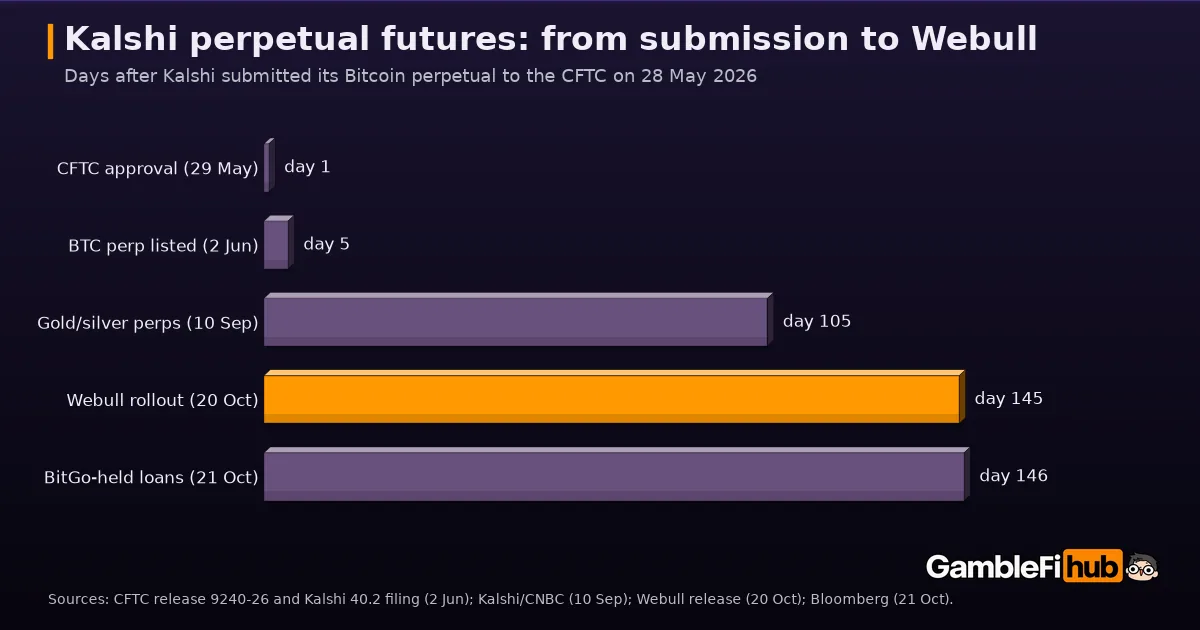
Perpetual futures, the no-expiry leveraged contracts that crypto traders mostly use on offshore exchanges, are moving onto a mainstream US brokerage. Webull announced on 20 October 2026 that it will offer perpetual futures to eligible US customers starting in November. The contracts are listed on KalshiEX, a CFTC-regulated designated contract market, and cleared by Kalshi Klear. A day later, Bloomberg reported that Kalshi’s own broker will let some clients borrow against crypto to fund margin on those trades.
What Webull announced
Webull says the rollout starts in November, with broader availability expected before the end of the year. The first contracts will cover Bitcoin and other crypto assets, with more products to follow subject to regulatory review and exchange listing requirements. Customers trade through their existing Webull Futures accounts, and at first only eligible US customers approved for futures trading get access.
Positions pay or receive periodic funding and are liquidated automatically if margin falls below maintenance requirements. Webull’s own disclosure adds that futures accounts are not protected by SIPC. The release does not state leverage limits or fees for the Webull offering; both are not disclosed. Tanmay Sheth, Webull’s managing director for its futures commission merchant, futures and prediction markets, says users will see margin requirements, funding rates, leverage and liquidation levels on the platform.
Webull’s US chief executive Anthony Denier framed the market size this way: “Perpetual futures have become a significant part of global derivatives markets, with annual volume reaching more than $90 trillion in 2025.” That is Webull’s figure, not one we have checked.
Bitcoin-backed loans as margin
According to Bloomberg, customers of Kalshi Prime, Kalshi’s US-registered futures commission merchant, will be able to borrow against digital assets held at BitGo and use the proceeds as margin for futures on Kalshi’s main exchange. Bloomberg describes a tri-party collateral setup: the loans come from Kalshi Katalyst, a lending affiliate of Kalshi Prime, and are secured by assets at BitGo Bank & Trust. Eligible collateral includes Bitcoin, Ether and stablecoins that comply with the GENIUS Act, Kalshi Prime chief executive Jeff Bandman told Bloomberg. Loan rates and loan-to-value limits were not disclosed.
Bandman told Bloomberg he built the product with “digitally native customers” in mind “who might already be trading perpetual futures in some of the unregulated offshore markets.” Bloomberg also reports that Kalshi has asked regulators to list perpetual-style products on oil and US stocks, and that Kalshi Klear applied to the CFTC last month to offer margin on select event contracts.
How Kalshi got here
The CFTC approved Kalshi’s Bitcoin perpetual, BTCPERP, on 29 May 2026, a day after Kalshi submitted it. Kalshi’s listing notice says the contract was first listed after the close of business on 2 June. Gold and silver perpetuals followed on 10 September; for those, Kalshi’s product notes list leverage of up to 15x on its own platform. The approval is still under attack: CME Group is suing the CFTC over it, and the agency argued in its latest brief that CME has no standing, as our report on the CME case explains.
Key facts
Broker: Webull, via Webull Futures LLC (CFTC-registered FCM, NFA member).
Exchange and clearing: KalshiEX LLC (DCM) and Kalshi Klear LLC (DCO).
Start: November 2026 for eligible, futures-approved US customers; wider availability expected before year end.
First products: Bitcoin and other crypto assets.
Leverage and fees on Webull: not disclosed.
Crypto-backed margin: Kalshi Prime clients, loans from Kalshi Katalyst against BTC, ETH or GENIUS-compliant stablecoins at BitGo Bank & Trust (per Bloomberg, 21 Oct 2026).
Why it matters for GambleFi
High-leverage crypto trading has been creeping into crypto casinos for years, as our look at 1000x leverage on casino sites such as Rollbit and BetFury shows. Kalshi is pulling the same kind of product into a regulated US futures account and now wants crypto holders to keep their coins and borrow against them. At the same time, states are still fighting Kalshi over its event contracts; see Utah’s lawsuit against Kalshi and Susquehanna. Perpetuals carry the risk of fast, automatic liquidation. The GambleFi FAQ covers the basics. This is a news report, not investment or gambling advice.