
Utah’s criminal case against Kalshi is over, at least for now. The Office of the Utah Attorney General filed a motion in the Third District Court on Monday, 23 November 2026, to dismiss all 14 counts against KalshiEX LLC and its co-founders Tarek Mansour and Luana Lopes Lara, it said in a statement on 24 November. On Tuesday afternoon Judge Todd Hilbig granted the motion and cancelled the founders’ initial appearance, according to court records obtained by FOX 13. The dismissal is without prejudice, which means the state can file the same charges again.
Why the state stepped back
The trigger was Kalshi’s own move. On 23 November it paused new trading in Utah, leaving users able only to close positions and withdraw. According to the attorney general’s office, Kalshi said it would geofence the state and monitor for Utah IP addresses trying to reach the site. The office says it then “reevaluated its position”. Its stance on the law has not changed: Utah treats prediction markets as gambling, and gambling of any kind is banned under the state constitution. Attorney General Derek Brown put the condition plainly: “Kalshi has pulled out of Utah, and if it returns, so will the charges.”
Kalshi welcomed the result but did not concede the legal point. General counsel Yaakov Roth wrote on X, as quoted by FOX 13, that “good faith jurisdictional disagreements should never be criminalized” and that Kalshi was ready to work with state attorneys general on “reasonable interim measures” until the courts decide who regulates prediction markets. A spokesperson told the Deseret News the company still hopes to return once its legal position is vindicated.
What is still open
Only the criminal track has closed. The state’s civil suit against five Kalshi entities and the market maker Susquehanna, filed on 20 October, continues, and with it the state’s estimate of $30.6 million to $61.2 million in fees from Utah accounts, which remains untested. Kalshi’s appeal of its federal loss is still at the Tenth Circuit. The CFTC’s own suit against Utah is waiting for a ruling on its restraining-order request, which Judge Robert J. Shelby heard on 20 November. Because the criminal case ended before any hearing, it never tested whether federal law shields a CFTC-registered exchange from state criminal charges.
The attorney general’s office also says cease-and-desist letters went to several of Kalshi’s competitors, and that seven companies, Kalshi included, have now agreed to stop operating in Utah. It warns it may bring civil or criminal cases against any company that offers or promotes sports betting to Utah residents.
Key facts
Case: State of Utah v. KalshiEX LLC, Tarek Mansour and Luana Lopes Lara; Third Judicial District Court, Salt Lake County; information dated 28 October 2026.
Counts dropped: 14 (one second-degree felony, 12 third-degree felonies, one class A misdemeanor).
Motion: filed 23 November 2026; granted 24 November by Judge Todd Hilbig, without prejudice.
Cancelled: founders’ initial appearance set for 4 December.
Still pending: Utah civil suit (filed 20 October); Kalshi appeal at the Tenth Circuit; United States and CFTC v. Utah (D. Utah 2:26-cv-01055).
Sources: Utah Attorney General statement, FOX 13 court records, Deseret News, our earlier coverage. Checked 25 November 2026.
Our numbers
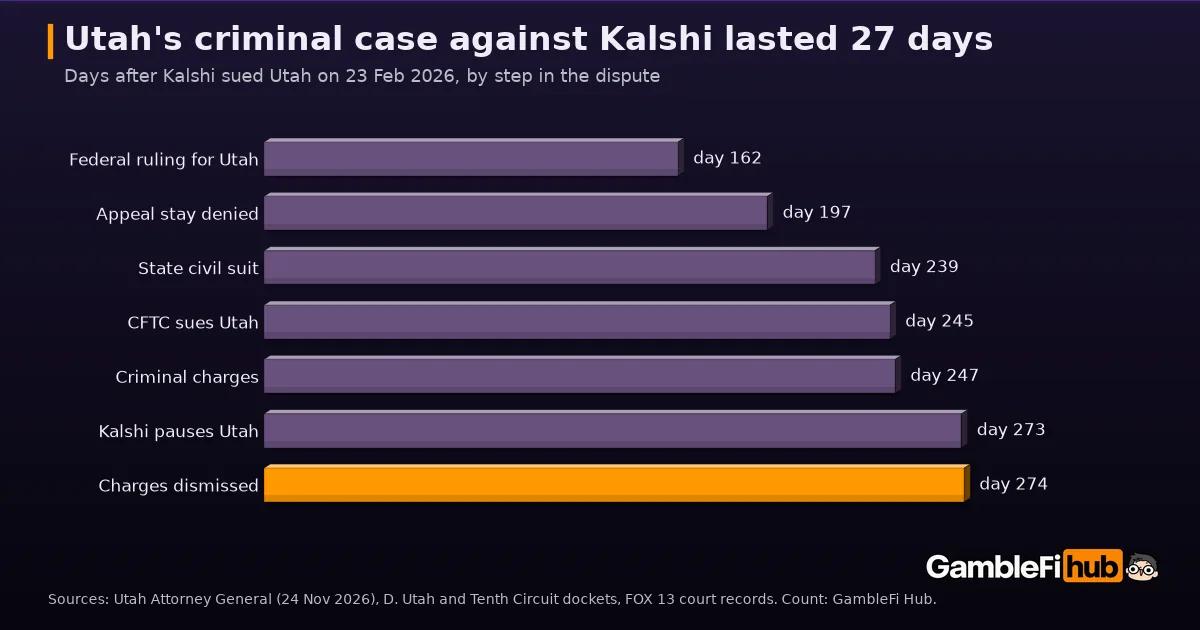
The criminal case lasted 27 days, from the information of 28 October to the dismissal on 24 November, and ended 10 days before either founder had to appear in court. Measured from the day Kalshi sued Utah on 23 February, the dismissal came on day 274, one day after Kalshi’s pause on day 273 (see chart). The federal ruling for Utah came on day 162; everything since then, the civil suit, the CFTC case and the charges, piled up in the last 112 days. As we reported when the charges were filed, the 12 felony counts for online gambling promotion matched 12 undercover sports bets totalling $114.87 in stakes and $3.36 in Kalshi fees. On those numbers, a test that cost the state’s agent a few dollars in fees led an exchange to switch off a state it puts at more than 177,000 users.
What it means for iGaming token platforms
Utah has shown that a state does not need a conviction to get what it wants. The threat of charges against named founders, plus a civil suit, was enough to make a CFTC-registered exchange geofence the state, as the New Mexico tribal injunction now requires on tribal land. Our reading, not a court’s: onchain prediction and betting products, including iGaming token (GambleFi) platforms such as SX Bet, have even less federal cover than Kalshi, and the new CFTC reporting rule does not reach them. If you use any of these platforms from a state that is prosecuting prediction markets, check its geoblocking and withdrawal terms first. Our GambleFi explainer and FAQ cover the basics. This is a news report, not legal or betting advice.