
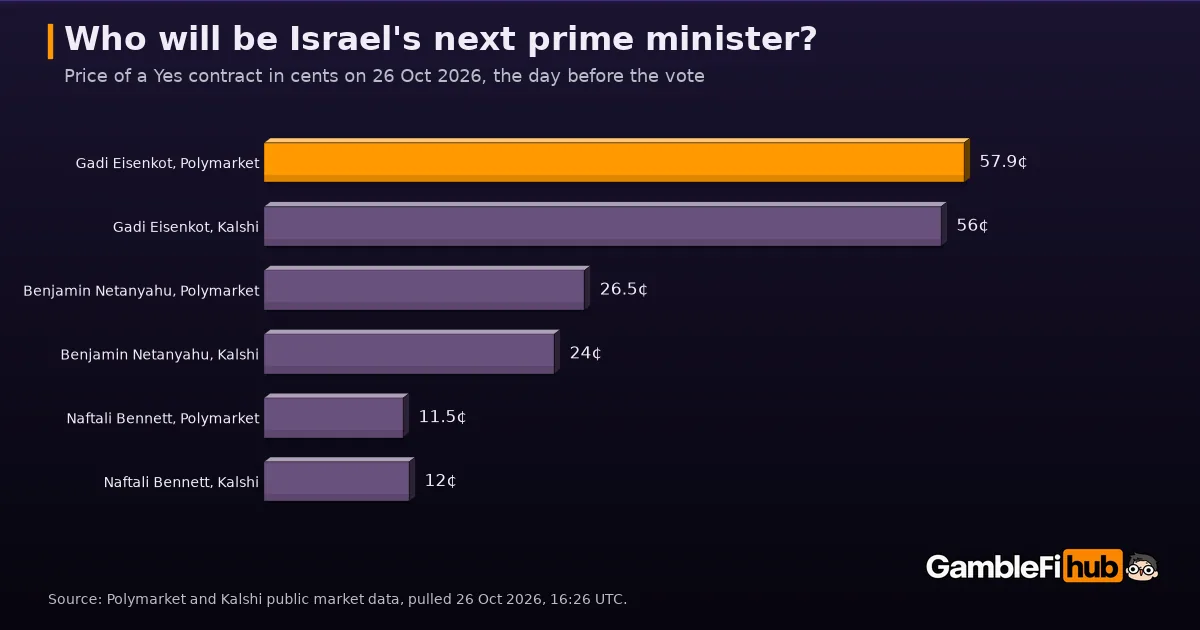
Israelis elect a new Knesset on Tuesday, 27 October, and prediction markets have taken a clear side that the polls have not. On Polymarket, the market on who becomes prime minister after the election has traded $55.1m since it opened in November 2025, including $1.97m in the past 24 hours. When we pulled the data at 16:26 UTC on 26 October, a Yes contract on Gadi Eisenkot cost 57.9 cents, against 26.5 cents for Benjamin Netanyahu and 11.5 cents for Naftali Bennett.
Kalshi’s version of the same question tells a similar story: Eisenkot last traded at 56 cents, Netanyahu at 24 and Bennett at 12. Kalshi’s 18 candidate contracts have changed hands about 1.51 million times in total, and 1.14 million of those trades were on Netanyahu.
Most of the money sits on Netanyahu
The price leader is not where most of the trading happened. On Polymarket, $12.4m of the volume came on the Netanyahu contract, roughly three times the $3.9m on Eisenkot and $4.3m on Bennett. A price only shows what traders will pay now; it is not a forecast from us.
On the separate question of which party wins the most seats, the Polymarket party market puts Eisenkot’s Yashar at 70.5 cents and Likud at 29.5, with $3.6m traded. Kalshi’s matching market last traded Yashar at 75 cents and Likud at 27.
What the final polls said
Israeli law bans new polls from the Friday before an election until voting ends, so the last surveys came out on 23 October. All three main TV polls put Yashar ahead of Likud, at 22 to 20 (Kan), 23 to 21 (Channel 12) and 22 to 19 (Channel 13), Israel National News reports. None gave either bloc the 61 seats needed for a majority. An average of ten final polls had Netanyahu’s bloc on 51.2 seats and the Jewish opposition parties on 51.4, with the two main Arab lists at 14.2. Channel 14’s final poll was the outlier, giving Netanyahu’s camp 62.
That gap matters for how these markets settle. The winner of the most seats is known on election night, but the prime minister is only known after coalition talks, which can take weeks. Kalshi’s rules close its market early once a prime minister is formally appointed and sworn in.
Key facts
Election: 27 Oct 2026, all 120 Knesset seats, 61 for a majority.
Polymarket next-PM market: $55.1m traded; Eisenkot 57.9¢, Netanyahu 26.5¢, Bennett 11.5¢.
Kalshi next-PM market: about 1.51m contracts traded; Eisenkot 56¢, Netanyahu 24¢, Bennett 12¢.
Most seats: Yashar 70.5¢ on Polymarket, 75¢ on Kalshi.
Data pulled: 26 Oct 2026, 16:26 UTC (17:26 CET).
Why it matters for GambleFi
Election markets like this one are a core product for onchain prediction markets. Polymarket’s international venue settles in stablecoins on Polygon and draws users from many countries, which puts it at odds with national betting rules. Election bets are also why Taiwan blocked Kalshi and Coinbase sites. The two venues stay close here, much as they did when we compared 31 US midterm contracts. How the international and US versions of Polymarket split their volume is covered in our earlier report. Onchain betting exchanges such as SX Bet work on the same model, and our GambleFi FAQ covers the basics. This is a news report, not legal, financial or gambling advice.