
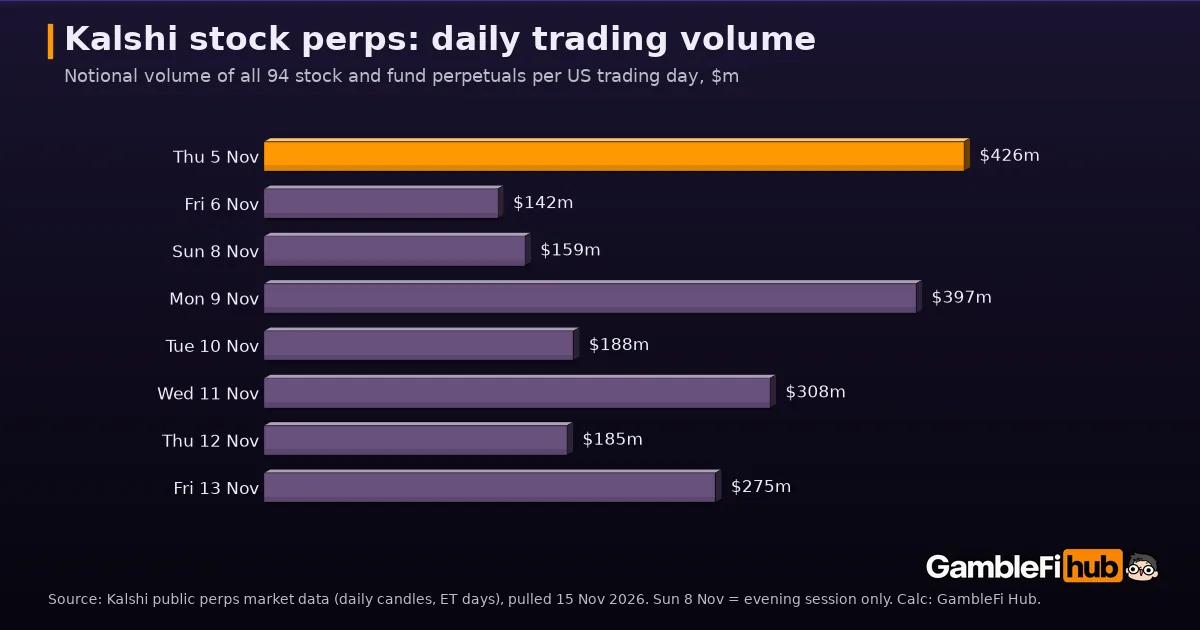
Kalshi, the US prediction market best known for event contracts, began listing perpetual futures on single stocks on 5 November. Our count of Kalshi’s own public market data shows that its 94 stock and fund perpetuals had traded $2.11 billion in notional value by the close on Friday 13 November. That covers eight sessions, including one Sunday evening.
The contracts are still under legal attack. A trade group backed by Cboe and Citadel Securities wants a federal court in New York to stop them, and a judge has already said the group is likely to win on the law.
What a stock perp is
A perpetual future tracks a price but never expires, so a trader can hold a long or short position for as long as the margin lasts. Kalshi’s market data puts the maximum leverage on most stock perps at about 5 times. Kalshi runs them through a separate perps API, alongside the crypto, metals, energy and index perps it already lists. We covered the listing filing and launch on 6 November and Kalshi’s earlier crypto perps push.
Key facts
Exchange: KalshiEX (CFTC-registered); Coinbase Derivatives and Bitnomial got the same approval.
Contracts: 94 stock and fund perpetuals; four (Amgen, Costco, McDonald’s, Qualcomm) first traded on 3 November, the rest from 5 November.
Volume to 13 November: $2.11 billion; launch day $426 million.
Open positions: $15.1 million on 15 November, up from $9.4 million after launch day.
Court case: Capital Markets Alliance Association v. CFTC, S.D.N.Y. 1:26-cv-09608.
Our numbers
We pulled daily data for every Kalshi perpetual on 15 November. Stock perps averaged $260 million per session. Launch day was the busiest at $426 million, followed by Monday 9 November at $397 million (see chart). Three names carried almost half of all volume: Nvidia $405 million (19.2%), SpaceX $313 million (14.8%) and Micron $304 million (14.4%). The top ten took 87%, leaving 13% for the other 84 contracts.
Most of the money turns over fast. A typical session traded about 17 times the $15.1 million left open at the end. Stocks are also not yet Kalshi’s main perps business: from 5 to 13 November they made up 17.9% of its perpetual futures volume, against 61.6% for crypto and 14.7% for index perps. Kalshi counts each trade at its full notional value, so these figures are turnover, not money deposited.
The court fight
The Capital Markets Alliance Association, whose members include Cboe, Citadel Securities and Healthy Markets, sued the CFTC on 3 November. That day Judge Valerie Caproni refused an emergency order, but found the group “likely to succeed” on its claim that the contracts are swaps for the SEC, not security futures under the CFTC, because they have no “sale for future delivery”. The request failed only because the claimed harm was “conjectural”. The case moved to Judge Lorna Schofield. Kalshi, Coinbase, Kraken’s parent Payward, DRW, Jump Trading and Paradigm filed a brief backing the CFTC. The SEC also opposed an injunction but did not say whether the contracts are futures or swaps; it can still overturn the exchanges’ rules and has until 31 December to decide. Court trackers report a hearing on the preliminary injunction set for 1 December.
Why it matters for GambleFi
The alliance’s reply already cites Kalshi trading volume as proof of harm, so every new session feeds the case on both sides. For crypto gambling, the bigger point is that 5x stock leverage is now sold by a regulated US exchange that started with event contracts, while crypto casinos such as Rollbit have long offered far higher leverage on crypto. Kalshi’s $40 billion valuation rests partly on products like this. Figures are from Kalshi’s public data and may be revised; the case is undecided. This is a news summary, not investment advice. The GambleFi FAQ explains how prediction markets differ from crypto casinos.