
Polymarket is now listing contracts on the price of AI computing power. Its compute perps are perpetual futures that track what it costs to rent one Nvidia GPU for one hour: the H100, the B200 and the B300. H100-USD went live on 26 November. Polymarket’s launch page, read on 28 November, describes all three markets as live. The documentation’s specification table still shows B200 and B300 as “planned for 27 November”, so we treat the specifications of those two as provisional. These are not event contracts. They sit closer to the stock and fund perps we covered in our Kalshi report.
How the price is set
One contract equals one GPU-hour, quoted in US dollars. The reference is an index from the data provider Ornn: the average of the latest 24 consecutive hourly rental prices, refreshed every 60 seconds. Polymarket says hourly prints are noisy, with single H100 hours moving more than 20% while the daily level stayed flat, which is why it averages them. Contracts are cash-settled in pUSD, never expire and trade around the clock. The documentation states that they give no right to any computing capacity and that “nothing is delivered”.
Leverage and margin
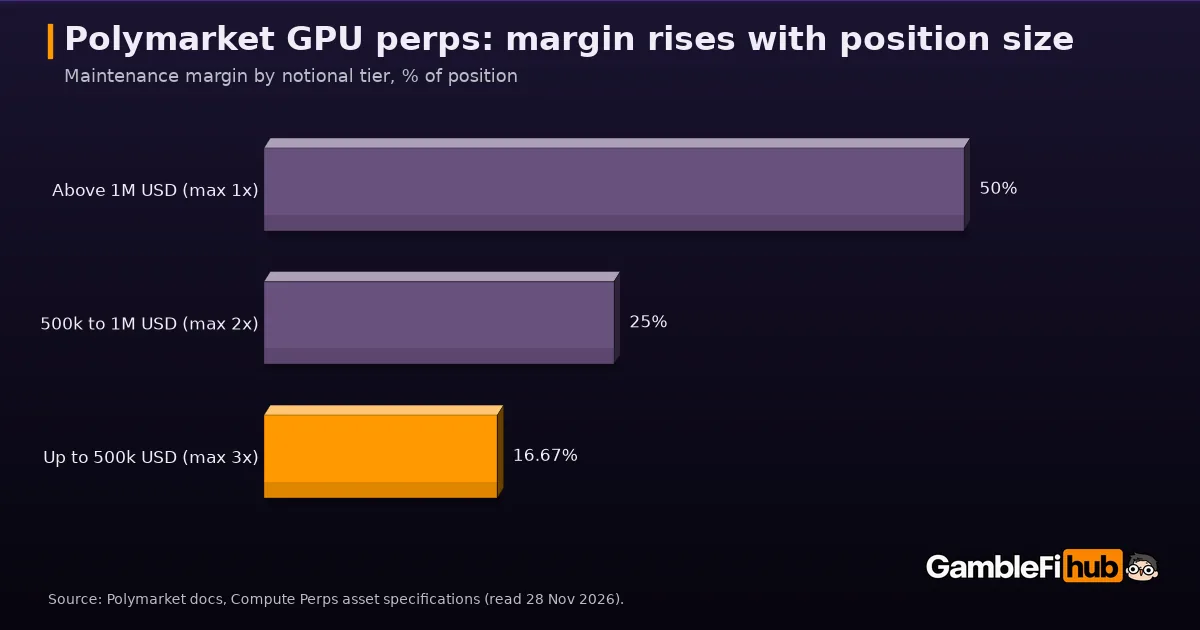
Maximum leverage is 3x for positions up to $500,000, 2x from $500,000 to $1 million and 1x above that. The maintenance margin, the cushion below which a position is liquidated, rises with size: 16.67%, 25% and 50%, applied step by step across the tiers. The H100 liquidation fee is 1.00%; for B200 and B300 it is listed as “not yet confirmed”. Funding is paid hourly directly between longs and shorts, capped at 4% per hour, and Polymarket says it takes no cut. A single market order is capped at $50,000 and a limit order at $250,000.
The single-source risk
Everything rests on one outside provider. If Ornn stops publishing, the last 24-hour average stays in use until its newest hourly print is 120 minutes old, then the index freezes and positions are not closed. Whether a frozen index would block orders that add risk “remains to be tested in staging”, according to the documentation. If Ornn corrects a published price, the corrected value is used from the next poll, but past trades, funding payments and liquidations are not revised. The page also notes that index values are shown to explain pricing “not as a view on future compute prices”.
Key facts
Markets: H100-USD (live since 26 November 2026), B200-USD and B300-USD (planned for 27 November in the specification table).
Reference: Ornn GPU rental index, 24-hour average of hourly prices.
Settlement: pUSD, no expiry, no delivery of compute.
Leverage: 3x up to $500,000; 2x to $1 million; 1x above.
Maintenance margin: 16.67%, 25% and 50% by tier (see chart).
Funding: hourly, capped at 4% per hour.
Sources: Polymarket documentation, Compute Perps asset specifications; Polymarket compute launch page. Read 28 November 2026. We have no independent volume or open-interest figures.
What it means
Prediction-market venues keep widening from yes/no contracts into leveraged derivatives on real-world prices. Polymarket’s fees on event contracts are in our fee comparison, and the on-chain rival Hyperliquid is covered in our outcome-market report. For readers following iGaming token (GambleFi) platforms, the point is the product category: a venue best known for event bets now also lists a leveraged contract whose price depends on one outside data feed. Our GambleFi explainer and FAQ cover the basics. This is a news report, not financial advice, and leveraged products can lose more than a deposit.