
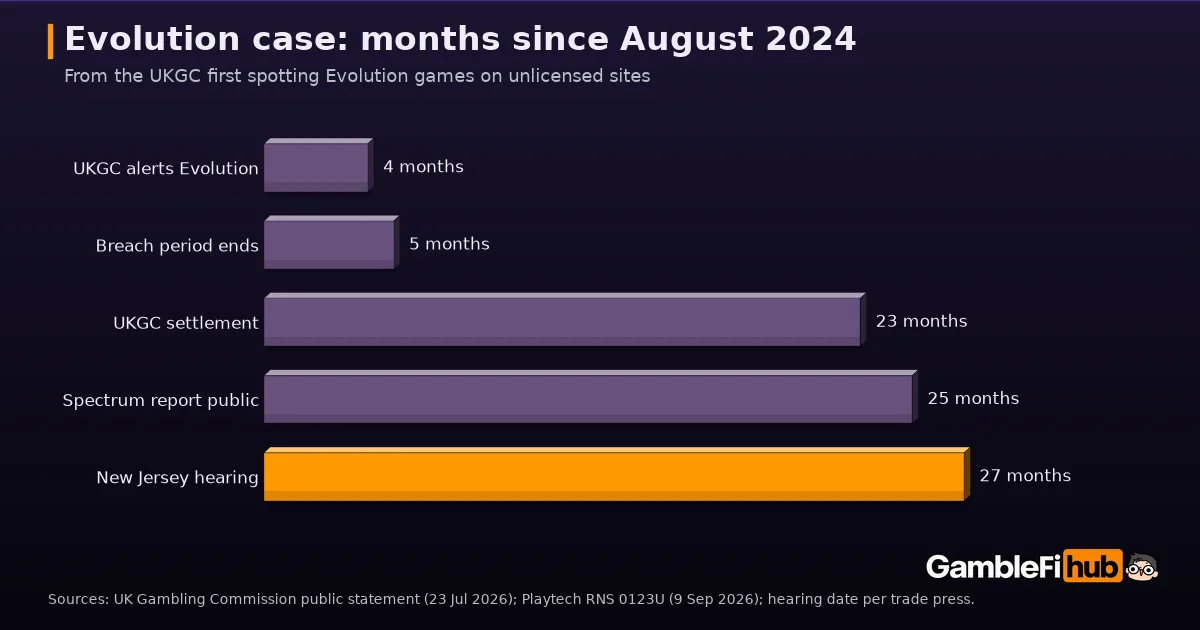
Evolution’s long defamation case against the private intelligence firm Black Cube reaches a hearing in the Superior Court of New Jersey on 16 November 2026. Black Cube wants the suit dismissed before it gets near a trial. For crypto casinos the interest lies in the evidence, not the defamation claim: two documents now in the public record describe how the live-casino supplier’s tables ended up on sites in markets where they were not allowed, and one of them names two crypto casinos.
What the judge is asked to decide
Black Cube is relying on New Jersey’s Uniform Public Expression Protection Act, the state’s anti-SLAPP law signed on 7 September 2023. It protects statements made to a government body or about an issue a government body is reviewing. Black Cube’s 2021 report on Evolution was sent to gaming regulators. If the law applies and Evolution cannot show a prima facie case, the court must dismiss the claims with prejudice and must award the winning side its legal fees. A defendant that loses can appeal as of right within 20 days. One limit matters here: the act only covers suits or claims brought after it took effect, while Evolution first sued in 2021. Trade press reports a three-day hearing before Judge John C. Porto, with a written ruling expected weeks later.
Evolution’s own report, now public
Evolution hired Spectrum Gaming Group to answer the Black Cube allegations. Black Cube filed that report in court on 8 September, according to a Playtech stock-exchange notice the next day. Playtech paid for the original Black Cube work and says Spectrum “corroborates fundamental aspects” of it, quoting a finding that Evolution “does not take any proactive steps” to check operators kept to their contracts. As quoted by EGR and iGaming Business, Spectrum’s testers placed bets on Evolution games at bitcasino.com and stake.com through a VPN with UAE addresses and found play also possible from Hong Kong, Singapore and Saudi Arabia. They could not get in from Iran, Sudan or Syria, and called those claims “unsupportable”. Spectrum did not find that Evolution knowingly allowed the play. Evolution disputes Playtech’s reading.
The UK settlement
The second document is the UK Gambling Commission’s public statement of 23 July 2026. It found five genuine Evolution games on six websites run by two operators without a GB licence, with large volumes of UK visits between December 2023 and November 2024. The regulator spotted the games in August 2024 and told Evolution in December, which then geo-blocked them. It found Evolution’s money-laundering risk assessment and controls inadequate from April 2024 to January 2025, and said the failings were serious enough to consider suspending the licence. The sites were not named. Evolution says the two operators “actively evaded” its restrictions and were cut off.
Key facts
Case: Evolution v. Black Cube and others, Superior Court of New Jersey; first filed 2021.
Hearing: from 16 November 2026, on Black Cube’s anti-SLAPP application.
Law: N.J.S.A. 2A:53A-49 to -61; mandatory fees for a winning applicant.
UKGC outcome: £4.75m payment in lieu of a penalty, an independent audit within 12 months and the Commission’s costs.
Breached conditions: licence conditions 12.1.1 and 12.1.2 (anti-money laundering).
Why it matters for GambleFi
Most crypto casinos and iGaming token platforms carry big-studio live tables through aggregators, and licensed suppliers are now being held to account for where that content ends up. The UK case shows the pressure works through the supplier’s licence, as it did with crypto source-of-funds checks in the Grosvenor settlement. If Black Cube loses, US discovery could reach operator contracts and geolocation records; if it wins, Evolution pays its fees. Either way, studios have more reason to cut aggregator deals that let play leak into banned markets, which mostly hits casinos with weak licences or still adapting to Curaçao’s new crypto rules. This is a news summary, not legal advice; see the GambleFi FAQ for how licensing works.