
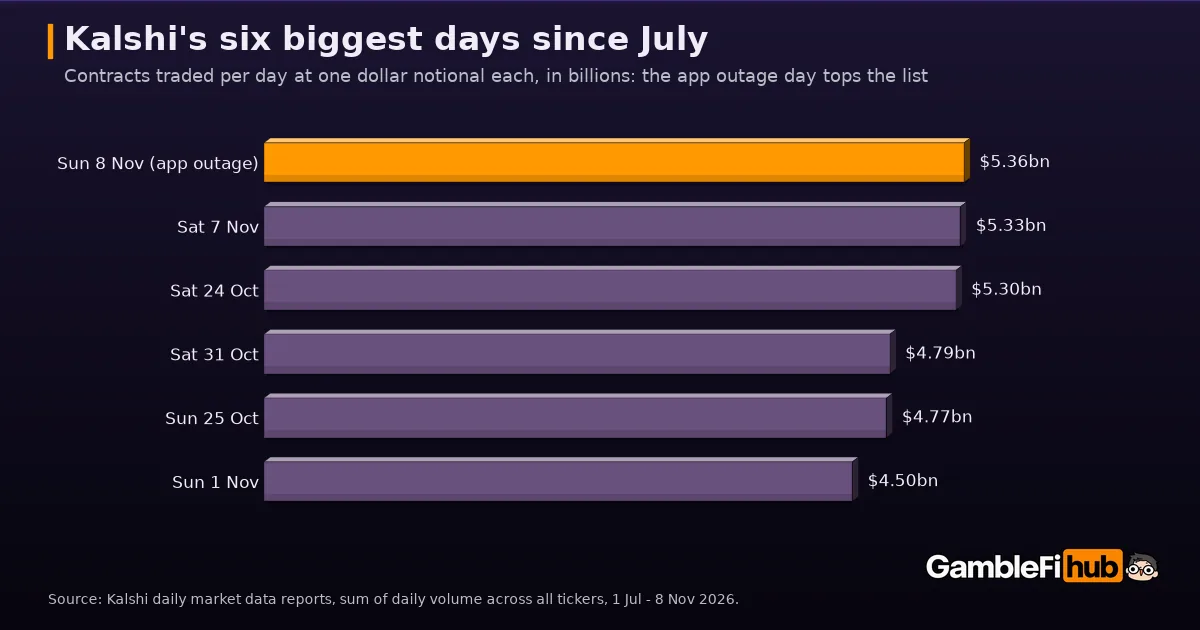
Kalshi’s app stopped loading for many users on Sunday, 8 November, from about 4 p.m. U.S. Eastern time (22:00 CET). The exchange’s own daily market data shows that the same day was also its busiest in more than four months. Adding up the daily volume of every ticker in Kalshi’s report for 8 November gives 5,358,951,921 contracts. Each contract pays $1, so that is $5.36bn of notional volume.
Two record days in a row
Saturday, 7 November, came in at 5,331,546,274 contracts in its daily report. That already beat Saturday, 24 October (5,296,258,958), the day trackers had named Kalshi’s record. Sunday then edged past both. We summed every daily report from 1 July to 8 November, and no other day passes $5bn. The six biggest days all fall on weekends since 24 October. Over the seven days from 2 to 8 November, Kalshi traded 29.69 billion contracts, against 24.93 billion in the week to 31 October.
Combos, Kalshi’s parlay-style contracts (tickers beginning KXMVE), made up 3.996 billion contracts, or 74.6%, of Sunday’s total, after 75.6% on Saturday. Trading outside combos came to 1.36 billion contracts on Sunday. That is less than on Election Day, 3 November, when combos were only 58.6% of the day. Notional volume counts every contract at its full $1 payout, even when a long-shot combo trades at a fraction of a cent. The headline overstates the cash at risk, which is why we read it as a measure of activity, not money wagered. For October our method gives 98.15 billion contracts, 68.0% of them combos.
What broke, and what kept running
User reports on Instatus jumped at 21:00 UTC and peaked at 3,958 an hour, 440 times the usual level. They stayed high for about three hours. Users wrote that the app would not load, that they could not log in, or that it showed no markets or positions. Instatus logged no incident post from Kalshi.
The matching engine appears to have kept working. Kalshi’s public trades API shows 17,086 trades in the minute from 22:30 UTC on Sunday, against 17,571 in the same minute on Saturday. The size of those trades was lower, though: 3.40 million contracts against 5.08 million. Kalshi’s maintenance documentation says that a pause outside its Thursday maintenance window means the exchange itself is down, and our spot checks found no gap of that kind. The pattern matches October 2025, when, according to InGame, the app and website failed on a college-football Saturday while API and broker trading carried on. App users then could not cancel resting orders that faster API traders could still hit.
Key facts
Biggest day: 8 November 2026, 5,358,951,921 contracts ($5.36bn notional), the highest from 1 July to 8 November.
Previous highs: 7 November 5.33bn; 24 October 5.30bn.
Combo share: 74.6% on 8 November; 75.6% on 7 November; 58.6% on 3 November.
Week 2–8 November: 29.69 billion contracts.
Outage: user reports from 21:00 UTC on 8 November, peak 3,958 an hour, about three hours; no incident post from Kalshi.
Sources: Kalshi daily market data, Instatus outage log, Kalshi trades API.
Why it matters for GambleFi
Most of Kalshi’s weekend activity is combos. That fits what we found when ten events held half of Kalshi’s open interest, and it underpins the $40bn valuation. When the app fails on the busiest day, the gap between app users and API traders becomes a cost for retail users. Rivals will use that. DraftKings is spending up to $700m on its own exchange, and Polymarket is moving to new contracts. Our 41-venue volume map and the fee comparison show where else that flow could go.
For iGaming tokens, the GambleFi coins of onchain casinos and betting exchanges such as SX Bet, the takeaway is simple. A venue’s uptime on peak days matters as much as its odds. Our midterm hit-rate check covers how accurate Kalshi’s prices were last week. This is an analysis of public exchange data, not investment advice. The GambleFi FAQ explains how prediction markets differ from crypto-casino tokens.