
Cambodia’s crackdown on scam compounds has slowed the crypto flowing into Sihanoukville’s casinos, but it has not stopped it. In a research note dated 28 October 2026, blockchain analytics firm TRM Labs says 34 land-based casinos it attributes to the coastal city received about $1.07 billion in crypto between 1 January and 7 September 2026. Some 99.9% of that arrived as USDT on the TRON network.
About $687 million, or 64%, went to casinos TRM links to networks designated by the US Treasury’s Office of Foreign Assets Control (OFAC). The note was picked up by trade and regional press in the first week of November.
What the numbers show
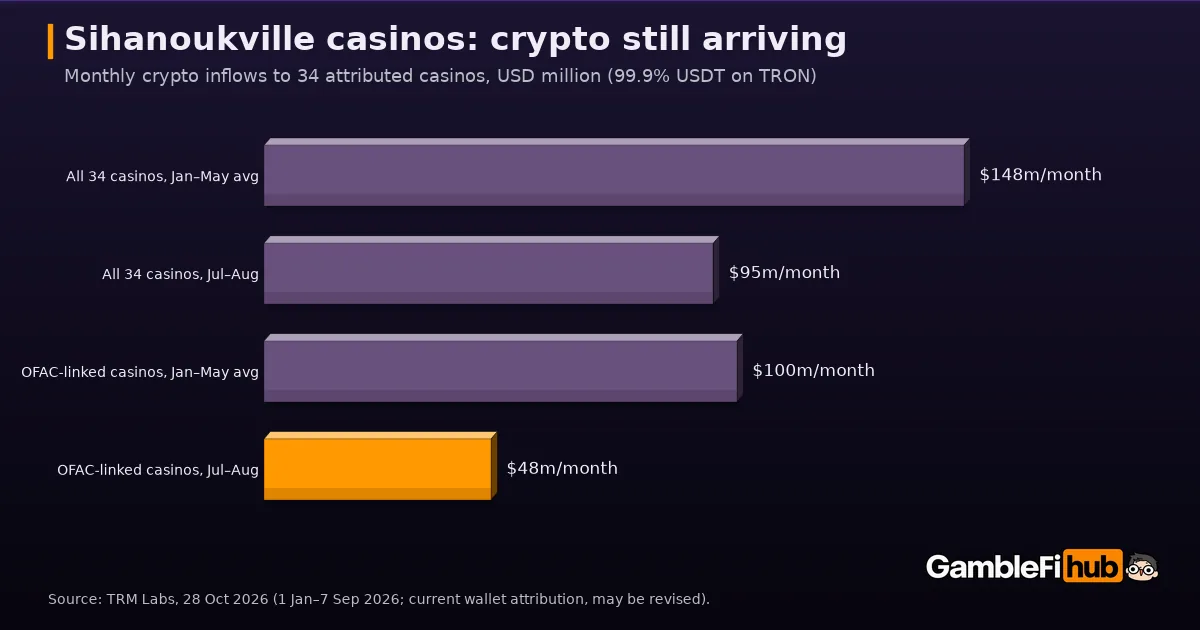
TRM puts average monthly inflows at $148 million from January to May, falling to about $95 million a month in July and August. Most of the drop came from the OFAC-linked group, down from roughly $100 million to $48 million a month. TRM itself flags the limit: operators rotate wallet addresses, so part of the decline may be money moving to wallets it has not attributed yet. The figures are a gross measure of crypto received by those wallet clusters, not casino revenue, and TRM says they may be revised.
The designations did not cut the pipes. From 23 April to 7 September, entities TRM attributes to the Xihu casino received $184 million and entities attributed to Huan Hai Bo Lai received $129 million. A casino tied to Jin Bei Group took $9 million after the Prince Group designation of October 2025. Huan Hai, whose wallets TRM can follow further back, received $264 million in the 2026 window, against $90 million over the same dates in 2025.
The sanctions and the licence cuts
On 23 April 2026 OFAC designated Cambodian senator Kok An and 28 people and entities in his network over scam centres that targeted Americans with digital-asset fraud. Treasury’s release names Xihu Resort Hotel Co Ltd as the operator of a Sihanoukville casino and says gambling companies operating inside it have been associated with organised-crime money laundering and human trafficking for cyber scams. Huan Hai Bo Lai International Investment Co Ltd sits on the same list, linked to Bolai founder Luo Hong.
On the Cambodian side, the state news agency AKP reported on 8 September 2026 that the government had revoked the licences of 18 casinos identified as involved in online scams and suspended nine more pending investigation. Jin Bei Group appears on the revoked list.
Key facts
Window: 1 January–7 September 2026; 34 Sihanoukville casinos attributed by TRM Labs.
Total received: about $1.07bn in crypto; 99.9% USDT on TRON.
OFAC-linked share: about $687m (64%); more than $320m received by three designated casino entities after their designation dates.
Monthly trend: $148m average (Jan–May) to about $95m (Jul–Aug); OFAC-linked casinos $100m to about $48m.
Enforcement: OFAC Kok An network designations 23 April 2026; Cambodia revoked 18 casino licences and suspended nine (AKP, 8 September 2026).
Sources: TRM Labs; US Treasury; AKP.
Why it matters for GambleFi
The rail TRM describes is the same one many crypto casinos and iGaming token (GambleFi) platforms use every day: USDT on TRON, cheap and fast, settling in seconds. TRM’s point for exchanges and stablecoin issuers is that screening a fixed list of sanctioned addresses misses casinos that rotate wallets, so indirect exposure needs watching too. That raises the bar for anyone handling deposits that may touch the region. Thailand is already pulling on the same thread, with its SEC and AMLO push on gambling wallets and the Shuffle crypto-flow inquiry; in the UK, source-of-funds checks on crypto were part of the Grosvenor settlement. See our Shuffle project page and the GambleFi FAQ for context. This is a report on published research and official statements, not legal or investment advice.